If you live in an apartment, getting on the air can feel like a cruel joke: no yard, no trees, a metal balcony, and a lease that specifically calls out "no antennas." The good news is that plenty of hams work HF and VHF every day from balconies and high-rises using compact, landlord-friendly antennas that don't scream "radio nut lives here."
In this guide we'll walk through the balcony-specific challenges, then look at several compact antenna options that actually work in the real world—what they do well, what they don't, and how to install them without annoying your neighbors or your property manager.
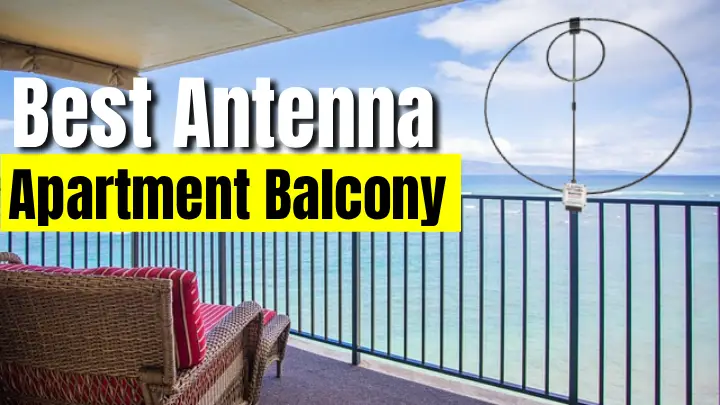
Understand Your Balcony, Building, and Rulebook
Before you buy or build anything, you need to understand three things: the physical space you have, what your building is made of, and what your lease or HOA allows. That will determine which antennas are realistic and how bold you can be with mounting hardware.
- Balcony size and shape: A shallow “Juliet” balcony might only work for a magnetic loop, while a full-depth balcony could support a short vertical or end-fed wire around the railing.
- Construction materials: Concrete and steel eat RF on HF, while glass and wood are usually kinder. Metal railings can either help (as part of the counterpoise) or hurt (if they detune the antenna).
- Neighbors above and below: Anything that could drip, rattle, or fall is a non-starter. Your antenna should not be able to blow loose and hit someone’s car or head.
- Rules and aesthetics: Many leases allow “temporary” or “non-permanent” accessories. Clamp-on mounts, dark-colored wire, and gear that looks like a TV accessory often get less attention.
Once you know your physical and political limits, you can narrow down to antennas that fit both the space and the rules instead of fighting them.
Safety First: RF, Lightning, and Good Neighbor Etiquette
Balcony antennas put your radiator physically closer to people than a typical backyard installation. That doesn’t mean they’re unsafe, but it does mean you should think about RF exposure, lightning, and basic courtesy from the start.
- Keep metal away from people: Don’t run bare wire where hands can grab it or where kids can touch it. Use insulated wire and keep it several inches away from handrails and furniture.
- Respect RF exposure limits: Use your national RF exposure calculator or ARRL charts, run the minimum power needed for reliable contacts, and avoid running full power on modes with high duty cycles if the antenna is close to occupied space.
- Weather and lightning: If your local code or common sense says “bond it,” add a proper ground connection where practical and disconnect the feedline during storms. A balcony loop or vertical is not a lightning rod, but it’s still metal outside.
- Noise and RFI: Choke your coax with ferrites near the antenna and radio, and keep an ear out for reports of interference. Being proactive goes a long way with neighbors.
Five Compact Balcony Antennas That Actually Work
There’s no single “best” antenna for every apartment. Instead, think in terms of families of antennas that are compact, reasonably efficient, and installable without drilling holes in someone else’s building.
1. Small Magnetic Loop for HF
Magnetic loops are the apartment HF operator’s best friend. A good commercial loop or a carefully built DIY design packs 20–40 meter capability into a circle roughly 3–5 feet across. They’re directional, relatively low-noise, and can be used either on a balcony or even indoors near a window.
- Pros: Very compact, can sit on a camera tripod or clamp to a railing, good for high-rise noise environments, no counterpoise needed.
- Cons: Narrow bandwidth (you’ll retune often), high voltages at the capacitor, performance drops rapidly if built or tuned badly.
- Best use: 20–40 meter digital and SSB work where space is extremely limited.
2. Short Loaded Vertical with Balcony Radials
A loaded vertical—essentially a shortened quarter-wave with a loading coil—can be clamped to a balcony rail and fed with coax, with a few short counterpoise wires tucked along the balcony floor or railing. Many mobile HF antennas can be adapted to this role using a heavy-duty mount.
- Pros: Simple to understand and tune, works well on higher HF bands, easy to move or remove.
- Cons: Efficiency depends heavily on the radial system and surroundings; nearby metal can detune it.
- Best use: 10–20 meter ragchews and DX with 25–100 watts and a small tuner.
3. End-Fed Wire Around the Balcony Perimeter
If your lease or HOA is more relaxed about wire than “antennas,” an end-fed half-wave or random-wire antenna can be routed around the balcony edge, up to the ceiling, or even disguised along the top rail. A compact transformer or matching unit lives near the feedpoint, with a short counterpoise wire hidden along the floor.
- Pros: Cheap, flexible routing, can be nearly invisible with thin dark wire, easy to reconfigure for different bands.
- Cons: Needs a good common-mode choke and tuner, sensitive to building metal and nearby wiring.
- Best use: Multi-band HF from 40–10 meters when you have 20–30 feet or more of run available.
4. Dual-Band Vertical or J-Pole for 2m/70cm
For local repeaters, simplex, and emergency monitoring, VHF/UHF is usually much easier from an apartment than HF. A small dual-band vertical or a DIY J-pole antenna can be clamped to the balcony rail or a short mast, giving you far better results than a rubber duck inside the building.
- Pros: Inexpensive, rugged, simple to mount, works great at modest heights, easy SWR matching.
- Cons: Mostly local coverage; building shadowing can create dead spots in certain directions.
- Best use: Repeater access, local nets, and neighborhood simplex with handhelds and mobiles.
5. Stealth “Window Line” or Inside-the-Glass Antennas
If your balcony is off-limits visually, you may still be able to mount an antenna inside the glass. Ladder-line J-poles, compact loops, and even some HF whips can be mounted just inside a sliding glass door, sacrificing some performance in exchange for near-zero visual impact.
- Pros: Nearly invisible from the outside, fully within your living space, no arguments with property managers.
- Cons: Building glass and metal frames reduce efficiency, especially on HF; RF is closer to people and electronics.
- Best use: VHF/UHF and limited HF when outside mounting is impossible.
At a Glance: Balcony Antenna Options Compared
| Antenna Type |
Typical Bands |
Install Difficulty |
Stealth Factor |
Comments |
| Magnetic Loop |
40–10 m (depending on design) |
Medium |
High (looks like "equipment") |
Great choice for extreme space limits; needs careful tuning. |
| Loaded Vertical |
20–10 m (some 40 m) |
Easy–Medium |
Medium |
Works well with a few short radials; easy to clamp to railings. |
| End-Fed Wire |
40–10 m (with tuner) |
Medium |
Very High |
Nearly invisible with thin dark wire; performance depends on routing. |
| Dual-Band Vertical / J-Pole |
2 m / 70 cm |
Easy |
Medium–High |
Excellent for local FM and repeaters; small and rugged. |
| Indoor / Window Antennas |
Primarily VHF/UHF |
Easy |
Maximum |
Least visible but most compromised; still beats a rubber duck inside. |
How to Install a Balcony Antenna Without Starting a War With Your Landlord
Once you’ve picked an antenna style, the next step is installing it in a way that’s safe, removable, and as invisible as you can reasonably make it. Here’s a practical process you can follow for most balcony-friendly antennas.
- Start with a clamp or stand, not a drill. Choose hardware that grips the balcony rail or sits on a heavy base. Camera tripods, light stands, and rail clamps are your friends here.
- Position the antenna away from people. Keep radiating elements above head height when possible and away from chairs, tables, and where people normally stand.
- Route coax the smart way. Avoid sharp bends around door frames and don’t crush coax under sliding doors. Use flat coax feedthroughs if needed or a small gap with foam weatherstripping.
- Dress cables neatly. Use dark cable ties or Velcro to secure coax along the balcony edges. Loose cables flap in the wind and draw attention.
- Tune at low power. Use 5–10 watts while you adjust antenna length, capacitors, or tuner settings. Once you have acceptable SWR, you can slowly bring power up.
- Confirm nothing moves in wind. Gently push and wiggle the antenna and coax. If anything shifts, rattles, or could work loose, fix it now, not during the first storm.
What to Expect On the Air From a Compact Balcony Antenna
A balcony antenna is a compromise by definition, but that doesn’t mean it’s useless. It means you should set realistic expectations and lean into modes and bands that play to your strengths.
On HF, expect to work plenty of regional contacts and a surprising amount of DX on 20 and 10 meters when conditions cooperate, especially if you use efficient digital modes like FT8 or JS8Call. On VHF/UHF, a small balcony vertical will usually outperform an indoor rubber duck by a wide margin and make your local repeaters feel “full quieting” again.
- Keep an eye on band conditions. Pick bands that are open rather than forcing a marginal antenna onto a closed band.
- Use digital modes to your advantage. Weak-signal digital modes can make a small antenna behave much bigger than it is.
- Log your results. Track which bands and directions work best from your specific balcony so you can orient loops or verticals where they perform best.
Practical Tweaks to Make a Small Antenna Act Big
The difference between a “meh” balcony antenna and a shockingly effective one is usually a handful of smart tweaks. None of these require more space—just a bit of extra care.
- Add ferrite chokes where it counts. A few turns of coax through clamp-on ferrites near the feedpoint and radio can cut noise and common-mode RF dramatically.
- Experiment with radial and counterpoise placement. For verticals and end-fed antennas, moving short radials off the concrete and away from metal can yield big improvements.
- Try different antenna heights and angles. Even a foot or two higher, or a slightly different tilt, can shift your radiation pattern and clear building obstructions.
- Keep connections clean and dry. Balcony environments are brutal on hardware. Stainless hardware and proper weatherproofing preserve performance over time.
Frequently Asked Questions
Can I really make HF contacts from a small apartment balcony?
Yes. You will not compete with a full-size beam on a tower, but plenty of hams work hundreds or thousands of contacts from compromised balcony antennas. Good band choice, efficient antennas like loops or end-feds, and smart operating practices matter more than sheer physical size.
Which is better for HF on a balcony, a magnetic loop or a short vertical?
If space is extremely tight or you want to operate indoors near a window, a magnetic loop is usually the better choice. If you have room for a clamp-on mast and a few short radials, a loaded vertical can be simpler to tune and may perform slightly better on the higher HF bands.
Can I legally put a ham radio antenna on my apartment balcony?
In most places you are allowed to operate a ham radio from an apartment, but your lease or HOA rules may restrict visible antennas or permanent modifications. Many operators use clamp-on, non-permanent, low-visibility antennas on balconies that satisfy both the landlord and the law. Always check your local regulations and building rules first.
Will my balcony antenna interfere with neighbors' TVs or Wi-Fi?
A properly installed and matched antenna used within your license power limits is unlikely to cause serious interference, but it can happen in cramped buildings. Keep your antenna and feedline as far as practical from neighbors' electronics, use ferrite chokes on coax and power cables, operate at the minimum power needed for a contact, and be ready to troubleshoot if someone reports interference.
Do I need a tuner with a balcony antenna?
Most compact balcony antennas benefit from a tuner because their feedpoint impedance varies with surrounding metal and the band you operate. A magnetic loop already tunes itself with its variable capacitor, but end-fed wires, short verticals, and any compromise antenna usually need either a small external tuner or a built-in radio tuner to keep SWR safe across a useful chunk of band.
Will my landlord notice my antenna?
There is never a guarantee, but low-profile choices help a lot. Dark wire along the top rail, compact antennas that resemble satellite or TV hardware, and clamp-on mounts that do not leave marks tend to attract less attention than bright whips sticking out over the sidewalk.
Is a Balcony Antenna the Right Move for You?
If you've been waiting for "someday" to get back on the air until you have a big yard and a tower, a compact balcony antenna is your ticket to stop waiting and start operating. It won't be perfect—but it will be real RF, real contacts, and real experience you can build on.
- You can operate safely and effectively from an apartment with the right antenna choice and installation.
- Magnetic loops, loaded verticals, end-fed wires, and small VHF/UHF antennas all have a place on modern balconies.
- A little optimization—ferrites, radials, routing, and tuning—goes a long way toward turning a compromise into a surprisingly capable station.
Don't wait for perfect conditions. Put something small on the balcony, tune it as well as you can, and start making contacts—you can always iterate from there.