When you're shopping for a Heltec LoRa board to run Meshtastic or your own LoRa projects, you'll quickly find yourself staring at two nearly identical options: the V3 and the V4. Both look similar, both claim the same radio chip, and both work with the same firmware. So what actually changed between versions, and does it matter enough to influence your buying decision?
This comparison breaks down the real differences between Heltec V3 and V4 boards without the marketing fluff. You'll learn which processor improvements matter, where power efficiency changed, how antenna performance compares, and whether the V4's upgrades justify spending a few extra dollars. If you're building Meshtastic nodes, running solar-powered remote sensors, or just trying to pick the right dev board for a weekend project, you'll know exactly which version makes sense for your setup.
Both boards remain solid choices in 2025. The V3 isn't suddenly obsolete, and the V4 isn't a revolutionary leap. Understanding the actual differences helps you spend money where it counts and avoid overpaying for features you won't use.
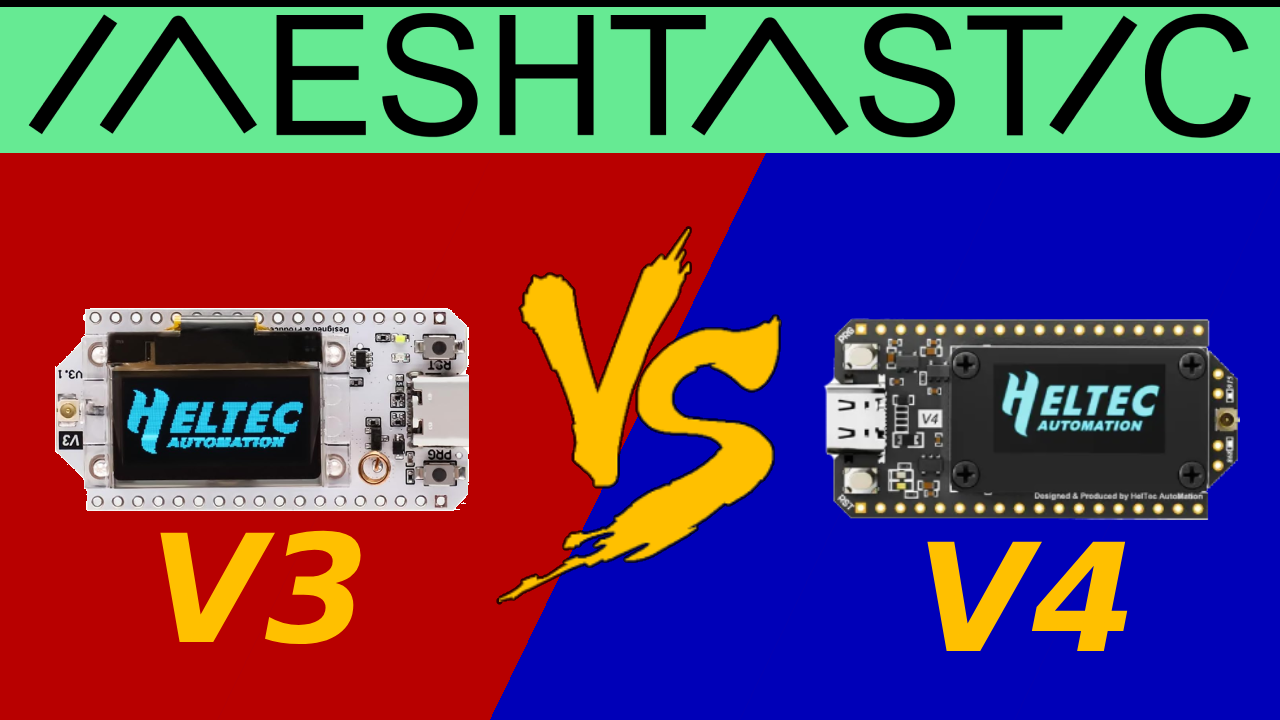
What Are the Heltec V3 and V4 Boards?
The Heltec WiFi LoRa 32 series provides ESP32-based development boards with integrated LoRa radios, OLED displays, and built-in lithium battery charging. These boards became popular in the Meshtastic community because they pack everything you need for a mesh node into a single, affordable package.
Both the V3 and V4 use the Semtech SX1262 LoRa transceiver, support 433 MHz and 915 MHz frequency bands depending on which model you order, and include a 0.96-inch OLED screen. They're designed for low-power IoT applications, remote sensing, and off-grid communications projects where you need long range without burning through batteries.
Heltec V3 vs V4 Quick Specs Comparison
| Feature | Heltec V3 | Heltec V4 |
|---|
| Processor | ESP32-S3FN8 | ESP32-S3FN8 |
| Flash Memory | 8 MB | 8 MB |
| PSRAM | 8 MB | 8 MB |
| LoRa Radio | Semtech SX1262 | Semtech SX1262 |
| Display | 0.96" OLED (128x64) | 0.96" OLED (128x64) |
| Battery Support | JST-PH 2.0 connector | JST-PH 2.0 connector |
| Sleep Current (typical) | ~180 µA | ~140 µA |
| PCB Design | Original layout | Improved RF routing |
| Antenna Connector | IPEX / U.FL | IPEX / U.FL |
| Typical Price | $22-26 | $24-28 |
Processor and Performance Differences
Both the V3 and V4 use the same ESP32-S3FN8 processor with dual-core Xtensa LX7 CPUs running at up to 240 MHz. You get 8 MB of flash storage and 8 MB of PSRAM on both versions. From a raw computing perspective, these boards perform identically when running the same workload.
The V4 doesn't upgrade the CPU or add more memory. What changed is how efficiently the board uses that processor. Heltec refined the power delivery circuit and improved voltage regulation, which translates to slightly lower power draw under load and significantly better sleep current. If you're running a Meshtastic node that spends most of its time asleep and wakes periodically to check for messages, that sleep current difference adds up over weeks and months of battery operation.
For projects that keep the radio awake and actively transmitting or receiving, you won't notice meaningful performance differences. The V4 might save you 20-40 milliamps during sleep, but transmit and receive current remains nearly identical because both boards use the same LoRa radio chip.
Power Consumption and Battery Life
This is where the V4 pulls ahead in measurable ways. The improved power management circuit drops sleep current from around 180 microamps on the V3 to roughly 140 microamps on the V4. That's about a 22% reduction in standby power, which matters if you're running nodes on battery or solar.
Real-world battery life depends heavily on your duty cycle. A Meshtastic node configured for typical use—checking for messages every few minutes, transmitting position updates occasionally—spends most of its time asleep. Over a month of operation, that 40-microamp difference can extend runtime by several days on the same battery capacity.
Here's what that looks like with a common 2000 mAh lithium battery:
| Usage Pattern | V3 Estimated Runtime | V4 Estimated Runtime |
|---|
| Sleep-only (no transmissions) | ~18 days | ~23 days |
| Typical Meshtastic node (1 msg/hour) | ~12 days | ~14 days |
| Active relay node (high traffic) | ~4 days | ~4.5 days |
| Continuous receive monitoring | ~36 hours | ~38 hours |
If you're building a node that plugs into wall power or runs off a vehicle battery, power efficiency doesn't matter much. But for solar nodes, backpack-portable setups, or remote sensors, the V4's lower sleep current makes a real difference.
LoRa Radio and Range Performance
Both boards use the identical Semtech SX1262 LoRa transceiver. Maximum output power, receiver sensitivity, and modulation options remain the same between V3 and V4. On paper, radio performance is identical.
In practice, the V4's improved PCB layout and better RF trace routing can result in slightly cleaner signals and marginally better sensitivity in some conditions. Heltec optimized the impedance matching between the radio chip and the antenna connector, which reduces reflections and improves power transfer to your antenna.
The difference is small. You're not going to see a doubling of range or suddenly reach nodes you couldn't before. In ideal conditions with quality antennas, both boards achieve similar maximum ranges—typically 5-15 km line of sight in urban areas, and 20-40 km in open rural terrain with elevated nodes.
Where the V4's RF improvements might show up is in marginal signal conditions: fringe contacts, weak signals near the noise floor, or environments with heavy RF interference. The cleaner signal path can mean the difference between decoding a weak packet and missing it entirely. But for most users in most situations, the radio performance feels the same.
Build Quality and Physical Design
The V3 and V4 share nearly identical physical dimensions and connector placement. Both measure approximately 50 mm x 25 mm, use the same mounting hole spacing, and position the battery connector, USB port, and antenna connector in the same locations. If you're 3D printing enclosures or designing custom cases, designs for the V3 will fit the V4 without modification.
Component quality appears similar across both versions. Heltec uses the same OLED display, the same JST battery connector, and comparable passive components. The USB-C connector on both models feels equally solid, and the antenna connector doesn't show meaningful differences in mechanical strength.
The V4's PCB is slightly thicker and uses a different solder mask color in some production runs, but that's purely cosmetic. The real improvement in the V4 comes from better trace layout and component placement that improves signal integrity and power efficiency rather than physical durability.
Both boards handle typical workshop abuse reasonably well. They're not ruggedized for extreme conditions, but they survive being tossed in a bag, mounted outdoors in weatherproof enclosures, and powered on and off repeatedly without issues.
Firmware and Software Compatibility
The V3 and V4 run identical Meshtastic firmware with full feature parity. When you flash Meshtastic to either board, the firmware automatically detects which hardware version you're using and configures itself appropriately. You don't need to select different builds or worry about compatibility.
Both boards support the same Meshtastic features: encrypted messaging, position sharing, remote node administration, GPIO control, sensor integration, and all current plugins. There are no "V4-only" features or capabilities locked to newer hardware.
If you're mixing V3 and V4 nodes in the same mesh network, they communicate without issues. The over-the-air protocol doesn't care which board version generated a packet. A message sent from a V3 node reaches a V4 node identically to how it reaches another V3 node.
For custom Arduino or ESP-IDF projects, both boards use the same development toolchain. Libraries, pinout definitions, and example code that work on the V3 work on the V4 without modification. The improved power management on the V4 happens transparently at the hardware level and doesn't require different code.
Real-World Use Case Recommendations
Understanding the differences helps, but what matters is which board fits your specific project. Here's where each version makes the most sense.
Choose the V4 If You're:
- Building solar-powered nodes: The lower sleep current extends runtime between charge cycles and reduces your required solar panel size. Get the V4 here.
- Running battery-only deployments: Every day of extra runtime matters when your node sits on a mountain for weeks at a time.
- Starting fresh projects: If you're buying new boards today, the small price premium for current-generation hardware makes sense.
- Optimizing for lowest power consumption: The V4 gives you the most efficient platform currently available in the Heltec lineup.
Choose the V3 If You're:
- Finding them on sale: If the price difference exceeds $5-7, the V3 delivers nearly identical performance for less money.
- Running AC-powered nodes: Power efficiency doesn't matter when your node plugs into a wall adapter or vehicle power.
- Building short-term or experimental projects: If you're testing concepts or building proof-of-concept prototypes, the V3 works perfectly.
- Matching existing hardware: If your current nodes are V3 and you prefer consistency in your deployment, stick with what you know.
Either Version Works Great For:
- Meshtastic mesh networking
- LoRa telemetry and sensor projects
- Ham radio APRS gateways
- Long-range remote control applications
- Learning LoRa development and experimentation
Pricing and Availability
As of November 2025, the Heltec V3 typically sells for $22-26 USD from major electronics distributors and directly from Heltec. The Heltec V4 runs $24-28 USD for the same frequency variant. That $2-5 premium for the V4 buys you better power efficiency and refined hardware but doesn't unlock new features or capabilities.
Both versions remain in active production and readily available. Supply tends to fluctuate based on global chip availability, but neither board shows signs of being discontinued soon. Heltec continues supporting both versions with documentation and firmware updates.
Watch for sales and bulk pricing. If you're buying multiple boards for a mesh network deployment, some vendors offer discounts at quantities of five or ten units. At those volumes, even a $2 per-board difference adds up quickly.
Third-party sellers on platforms like AliExpress, Amazon, and eBay sometimes list the V3 at lower prices, especially when retailers clear inventory to make room for V4 stock. Just verify you're buying genuine Heltec hardware and not clones with suspect quality control.
How Do They Compare to Other LoRa Boards?
The Heltec lineup competes with other popular Meshtastic hardware options including LilyGO T-Beam, RAK WisBlock, and standalone SX1262 modules. Each platform brings different strengths.
Compared to the LilyGO T-Beam, Heltec boards are more compact and include integrated displays, but the T-Beam adds built-in GPS and better antenna options out of the box. For Meshtastic applications that need position tracking, the T-Beam remains the easier starting point.
RAK WisBlock systems offer more modularity and better power management at higher cost. If you're building custom sensor nodes or need specific radio frequencies, RAK's modular approach provides more flexibility than Heltec's all-in-one boards.
For pure LoRa experimentation and Arduino projects, standalone SX1262 breakout boards cost less than Heltec options but require separate microcontrollers and more complex wiring. The Heltec boards win on convenience and integration.
Neither the V3 nor V4 excels at everything, but both deliver excellent value for general-purpose LoRa development and Meshtastic mesh nodes. The integrated display, battery charging, and proven hardware design make them popular default choices.
Frequently Asked Questions — Heltec V3 vs V4
Is the Heltec V4 worth upgrading from V3?
If your V3 boards work fine, there's no compelling reason to replace them. The V4 offers better power efficiency and slightly improved RF performance, but it's not a night-and-day difference. Save your money unless you're specifically struggling with short battery life or need every last hour of runtime.
Can I mix V3 and V4 boards in the same Meshtastic network?
Yes, absolutely. They use the same LoRa radio parameters and run identical firmware. V3 nodes communicate with V4 nodes without any configuration changes or compatibility issues. Build your mesh with whichever hardware you can source at good prices.
Which board has better range for Meshtastic?
Range is virtually identical between V3 and V4 when using the same antenna and settings. The SX1262 radio performs the same on both boards. Real range depends much more on antenna quality, mounting height, and terrain than on which board version you choose.
Does the V4 run cooler than the V3?
Both boards run cool under normal Meshtastic workloads. The V4's improved power management might result in marginally lower temperatures during transmit, but you won't feel a difference with your hand. Neither board suffers from heat problems in typical outdoor enclosures.
Are there any V4-exclusive Meshtastic features?
No. Meshtastic firmware treats both boards identically. All current features, plugins, and capabilities work on both V3 and V4 hardware. Future firmware updates will continue supporting both versions for the foreseeable future.
Which board is better for learning LoRa and Meshtastic?
Either one works perfectly for learning. The V3 costs slightly less and delivers the same learning experience. If budget matters, grab the V3. If you're buying today and prices are close, the V4 gives you current-generation hardware to grow into.
Final Verdict: Which Heltec Board Should You Buy?
The Heltec V4 represents a solid incremental improvement over the V3 without reinventing the platform. Better power efficiency and refined RF layout make it the smarter choice for new projects, especially if you're building battery-powered or solar nodes where every milliamp matters. The small price premium buys you current hardware that will stay relevant longer.
But the Heltec V3 isn't obsolete or inferior. It remains a capable, proven board that handles Meshtastic and LoRa projects without compromise. If you find V3 boards on sale or already own them, there's no urgent need to upgrade. They'll continue working reliably for years.
The real decision comes down to your specific use case. Building solar nodes or optimizing for maximum battery life? Go V4. Running wall-powered stations or need to save a few dollars per board? The V3 delivers excellent value. Starting fresh and prices are close? The V4 is the obvious choice.
Either way, you're getting solid hardware backed by active firmware development and a strong community. Both boards will serve you well whether you're building your first Meshtastic node, experimenting with LoRa projects, or deploying a full mesh network across your neighborhood. Focus less on chasing the latest version and more on getting your nodes deployed, tuning your antennas, and building coverage where it matters.
🛒 Ready to Build Your Meshtastic Network?
Heltec V4
Best for battery/solar power, newest hardware, 22% lower sleep current
$24-28
Buy Heltec V4 on eBay
Both boards ship from reliable eBay sellers with fast shipping and buyer protection.
References & Further Reading
- Official Heltec documentation and datasheets for V3 and V4 hardware specifications
- Meshtastic firmware repository and hardware compatibility documentation
- Community testing data from Meshtastic Discord and forums comparing real-world battery performance
- ESP32-S3 technical reference manual for processor capabilities and power management
- Semtech SX1262 datasheet for LoRa radio specifications and performance characteristics