If you hike a summit for SOTA, drag a go box to the park, or run a portable field station, your choice of coaxial cable matters a lot more than it does for a fixed shack. The wrong feedline can eat half your power, kink into a mess, or fail after a couple wet activations. The right cable disappears into the background so you can focus on logging contacts instead of fighting your gear.
Coax for a base station is easy: you drop something chunky and low loss like LMR-400, tie it down once, and forget it for the next decade. Portable ham radio is different. Now you care about every ounce in the pack, how well the cable coils, and whether the jacket will survive being dragged through dirt, gravel, and a car door or two.
In this guide we will look at how common coax sizes like RG-174, RG-316, RG-58, RG-8X, and LMR-240UF behave in the real world. The goal is not to crown a single "best" cable, but to help you pick the best coax for your style of portable operations, whether that is ultralight QRP, casual POTA weekends, or a more serious emergency comms kit.
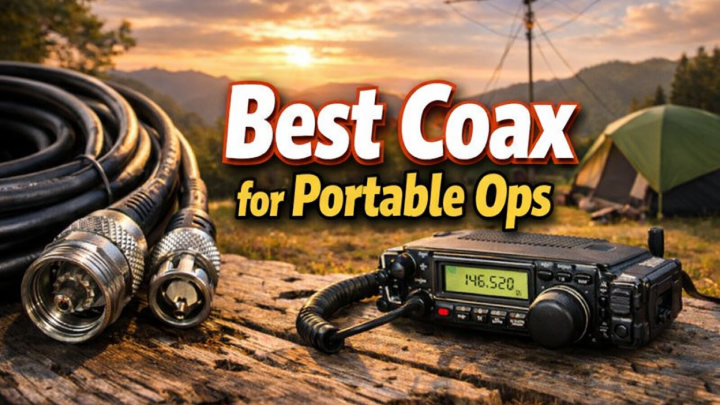
What makes coax "good" for portable use?
Portable coax is a compromise between RF performance and packability. On one end you have ultra thin cables such as RG-174 and RG-316 that are incredibly light and flexible but quite lossy, especially at VHF and UHF. On the other end you have chunky lines like LMR-400 that are very low loss but heavy, stiff, and annoying to manage in the field.
Quick coax recommendations for portable operations
| Use case |
Recommended coax |
Why it works |
| Ultralight HF QRP (SOTA, backpacking) |
RG-316, 25-50 ft |
Very light and flexible with acceptable loss on HF when runs are kept short. |
| General POTA / field day (HF + 2 m) |
RG-8X or LMR-240UF, 25-75 ft |
Much lower loss than micro coax while still coiling easily and riding well in a go bag. |
When you choose coax for portable ham radio, think about five basic levers you can move:
- Loss (attenuation): How many dB you lose in the feedline between the radio and antenna. This depends on cable type, frequency, and length.
- Weight and bulk: How much space the cable takes in your pack and how heavy it feels after a mile of uphill hiking.
- Flexibility and handling: Some jackets stay flexible in cold weather and coil nicely. Others fight you every step of the way.
- Durability: Field coax gets stepped on, pinched in doors, dragged across rocks, and soaked in rain. Cheap jackets and bad strain relief show up fast.
- Connectors: Factory terminations and strain reliefs are often the weakest link, especially on thin coax used with heavier adapters.
If you mostly run HF below 20 meters, you can get away with smaller coax than you would for a 2 meter or 70 centimeter activation. As frequency goes up, loss climbs quickly and thin cables stop making sense except for very short jumpers. Keep that in mind when you decide what to keep in the backpack vs what stays in the car with a larger mast or beam.
How to choose coax for your next portable activation
Instead of memorizing an attenuation chart, use a simple process every time you plan a trip. A few minutes of thought before you throw gear in the bag can save a pile of frustration in the field.
- Step 1: Decide which bands and modes you care about. For 40 and 20 meter SSB at 10 watts, loss is less critical than for 2 meter FM or 70 centimeter digital voice at 20 to 50 watts.
- Step 2: Estimate the maximum feedline length you need. Include the extra distance to keep the radio somewhere safe and comfortable instead of at the base of the mast. Round up a bit for routing.
- Step 3: Match the coax to that job. For short HF-only runs, RG-316 is often fine. For longer runs or any serious VHF work, bump up to RG-8X or LMR-240UF to keep loss under control.
As a quick rule of thumb, try to keep total feedline loss under about 2 dB at your main operating frequency. That means you are losing less than a third of your power in the coax, which is tolerable for portable work where antennas are already a compromise. Many online calculators will help you plug in cable type, frequency, and length so you can check your choice before you build anything.
Popular coax types for portable operations
Here is how some common 50 ohm cables behave when you drag them into the field. There are many brands and jacket variations, but the broad categories are consistent enough to plan around.
- RG-174 / RG-316: Very small diameter and extremely flexible. Great when pack size matters more than loss, such as ultralight HF QRP with short runs. They get lossy fast above HF and do not love repeated abuse at the connectors.
- RG-58 / LMR-195: A mid size option that works well for moderate HF and VHF runs. Common, affordable, and easy to find pre-made. Loss is noticeably higher than RG-8X or LMR-240, but you may not care for shorter lengths.
- RG-8X / LMR-240UF: A sweet spot for many portable stations. Thicker than RG-58 but still flexible enough to coil. Much better loss figures, especially at 144 and 432 MHz, without the weight penalty of LMR-400.
For most hams doing POTA, field day, or casual portable HF and 2 meter work, a 25 to 50 foot length of RG-8X or LMR-240UF ends up being the most used cable in the kit. Very long VHF and UHF runs or high power contest style setups may justify heavier low loss cables, but that is the exception rather than the rule for backpack portable.
How coax choice shows up on the air
It is easy to look at a loss chart and think "That’s not so bad" when you see a couple of dB. In the real world, those dB stack with antenna compromises, terrain, and noise. A 3 dB loss in the cable on a 10 watt QRP rig means you are effectively running 5 watts at the antenna. Combine that with a low inverted vee hung from a short telescopic mast and you will feel the difference when calling weak stations.
On VHF and UHF, coax loss is even more unforgiving. A 50 foot run of thin RG-174 at 146 MHz might eat more than half your power. If you are trying to work a distant repeater or simplex during an emergency drill, swapping that run for RG-8X or LMR-240UF can be the difference between scratchy, marginal audio and a clean, solid signal. The antenna still does the heavy lifting, but the feedline can quietly ruin your day if you ignore it.
Practical coax tips for field operators
After a few activations you will develop your own habits, but these simple practices keep coax happier in the field and cut down on mystery failures later.
- Build or buy one "primary" coax that matches your most common activation style, plus one backup jumper you can repurpose if something fails.
- Use strain relief at the radio and antenna ends. A short loop tied off to your mast or support takes stress off the connector and keeps thin coax from tearing at the crimp.
- Coil your cable loosely in large loops and secure it with soft straps or hook and loop ties. Tight, sharp coils and knots are how kinks and broken shields happen.
It also helps to standardize on connectors as much as you can. If your portable antennas use BNC but your radios use SO-239, keep a couple of BNC to PL-259 jumpers and adapters in a small pouch with your coax. Labeling each cable with length and type using heat shrink or tape saves a lot of guessing when you dig around in the bottom of a bag at dusk.
Frequently Asked Questions
How much coax do I really need to carry for portable operations?
For most portable setups, 25 to 50 feet covers a wide range of scenarios. Shorter coax keeps loss low and packs smaller, but it may force the radio into awkward or unsafe spots. If you regularly operate from picnic tables or shelters away from the antenna support, a 50 foot run of RG-8X or LMR-240UF is a nice universal length.
Is ultra thin coax like RG-174 ever a good idea?
Yes, as long as you treat it honestly. For low band HF QRP with very short runs, RG-174 or RG-316 is often fine and keeps your pack weight low. They are less suited for high duty cycle digital modes or long runs on 2 meters and up. Many operators carry a thin 10 to 25 foot jumper for flexible antenna mounting plus a heavier main cable for longer runs.
Should I buy pre-made coax or build my own?
Pre-made cables from reputable vendors are hard to beat for most hams. You get consistent terminations, molded strain relief, and tested assemblies, which is especially helpful with small diameter cables that are tricky to connectorize cleanly. If you already have a good crimp kit and know how to test your work with a meter or analyzer, building custom lengths gives you more flexibility.
What about ferrites and common mode chokes on portable coax?
A few clip on ferrites near the radio end or a simple coax choke (several turns of the feedline near the antenna) can tame common mode currents that make portable setups noisy or unstable. They do not change the basic loss of the cable, but they can improve how cleanly your antenna system behaves, especially with end fed wires and random wire tuners.
What is the best all-around coax for portable HF and VHF?
For most portable HF and VHF work, a good all-around choice is RG-8X or LMR-240UF in a 25 to 50 foot length. You get much lower loss than tiny micro coax while keeping the cable light and flexible enough to pack in a backpack.
How long can my portable coax run be before loss becomes a problem?
For QRP HF, 50 feet of RG-174 might be acceptable on 40 or 20 meters, but it becomes painful on 10 meters and up. On VHF, try to keep lossy cable under 25 feet or switch to a lower loss type like RG-8X or LMR-240UF if you need to go longer.
So which coax should you pack?
There is no single perfect coaxial cable for every portable activation, but a small family of cables covers almost anything you are likely to do. Start by being honest about the bands you use most, the distances you actually need, and how much weight you are willing to carry. Then pick a cable that hits a sensible middle ground instead of chasing the lowest possible loss at any cost.
- Use ultra thin coax like RG-316 for short HF QRP runs when every ounce in your pack matters.
- Rely on RG-8X or LMR-240UF as a solid general purpose choice for POTA, field day, and mixed HF plus 2 meter work.
- Keep feedline loss under roughly 2 dB at your main operating band and invest in good connectors and strain relief.
If you tune your coax choices the same way you tune your antennas, your portable station will feel a lot bigger than the small box of gear you carried into the field.