If you've ever heard someone say "Just get a CB" and someone else say "Skip it and get your ham ticket," they're both pointing at real strengths. CB radio is the quickest way to get on the air and chat, especially from a vehicle or around town. Amateur (ham) radio asks you to learn a little first, but it pays you back with more places to operate, more ways to communicate, and a community that's built around improving your skills. This is a fair CB vs ham radio comparison, plus the not-overwhelming reason a ham radio license is usually worth it.
Let's start with what CB actually is. In the US, Citizens Band lives around 27 MHz (often called "11 meters") with 40 channels. It's popular for road info, casual local chat, and the occasional long-distance "skip" when conditions are right. A basic CB setup can be as simple as a radio, a mag-mount antenna, and a power lead. If your goal is to talk from a truck, convoy, job site, or rural property with people who already own CBs, it can be the most practical answer.
Ham radio is a different deal. It's not one band or one radio service, it's a whole set of allocations across HF, VHF, and UHF (and beyond), with multiple license classes and a long list of permitted modes. That sounds like a lot, but the upside is flexibility: local coverage through repeaters, regional HF contacts when you want them, digital modes for weak-signal work, satellites, APRS, and the ability to experiment legally with antennas and station setups. If you find yourself reading articles on radio and antennas, you're already halfway into the ham mindset.
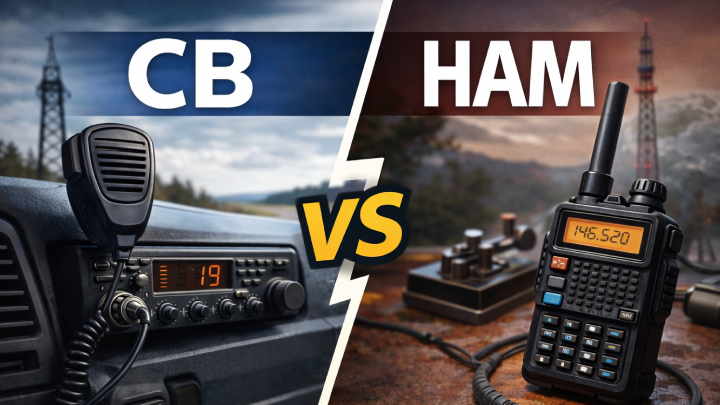
CB radio: why it still makes sense
CB's biggest advantage is that it meets people where they are. No test. No callsign. You can buy a radio today and be talking tonight. For vehicle-to-vehicle comms, CB is also nicely "self-contained" because a lot of folks already have it installed. And even though CB is limited, it's not useless: with a decent antenna and clean installation, you can get reliable local coverage that beats cell service in the places where cell towers aren't your friend.
CB vs ham at a glance (what changes in real life)
| Metric |
Value |
Why It Matters |
| Barrier to entry |
CB: buy and talk | Ham: quick study + exam |
CB wins on speed. Ham wins over time because the license unlocks options you can't buy with accessories. |
| How you extend your range |
CB: mostly antenna and conditions | Ham: antenna + repeaters + band choice |
CB upgrades are mostly hardware. Ham upgrades can be as simple as choosing a different band, repeater, or mode. |
A simple path from CB to your first ham contact
People don't leave CB because it's "bad." They leave because they hit the ceiling. You improve the antenna, clean up the install, chase down noise, and you're still stuck in one slice of spectrum with the same constraints. If you're curious about ham but you don't want it to feel like school, do it the easy way. First, listen around with a scanner or an SDR, or have a local ham walk you through a repeater. Next, aim for the Technician license so you can actually get on the air without fighting the band. Then keep your first station simple so you learn what matters instead of buying your way into confusion. If you want a clean start, Getting Started will save you a bunch of trial-and-error purchases.
Where CB and ham overlap (and where they don't)
Both services scratch the same itch: push-to-talk communication that doesn't rely on an app, a subscription, or a working cell network. Both reward a good antenna, clean power, and smart operating habits. The difference is what happens after the novelty wears off. On CB, you tend to run the same channels, with the same rules, with limited ways to adapt when interference is bad or range isn't there. On ham, you can change bands, change modes, use repeaters, join nets, or build something weird and learn from it.
- CB is great when your friends, family, or work crew already uses it and you just need local comms that are easy to explain.
- Ham shines when you want to communicate reliably across a wider area, try digital modes, or learn why your station behaves the way it does.
- CB has a culture of "just make it work." Ham has that too, but it also has a culture of sharing knowledge, running nets, and helping newcomers level up.
Range, clarity, and getting heard when it counts
This is the part people argue about, so let's keep it grounded. CB range is heavily influenced by antenna quality, antenna placement, and local noise. In flat terrain with good installs, you can do useful local communication. But it can also get frustrating fast in noisy cities or hilly terrain, because you're limited in how you can solve the problem. When skip rolls in, CB can travel far, but it isn't something you can schedule or depend on. It can be fun, and it can also be chaos.
Ham gives you more levers to pull. If you want local, VHF/UHF repeaters can extend your footprint dramatically. If you want regional or long-distance, HF bands and modes give you choices that match the conditions. And if you care about clarity, you can pick a mode and bandwidth that fits the job. None of that makes ham "magic," but it does mean you spend less time stuck and more time experimenting with solutions that are legal and repeatable.
Practical tips before you spend money
If you're deciding between CB and ham, the trap is thinking the radio body is the whole story. Antennas, placement, and expectations matter more than brand names. These three tips save people a lot of money (and a lot of forum arguments).
- Buy the best antenna setup you can mount safely, and take the time to install it cleanly. This applies to CB and ham. A mediocre radio on a great antenna usually beats the opposite.
- Figure out who you're trying to talk to. If the people you care about already live on CB, start there. If you want to meet new operators, join nets, or work repeaters, ham has more active on-ramps.
- Don't delay the license thinking it's a big deal. The Technician test is very doable with steady study, and it's the one thing you can't bolt onto a CB later.
Frequently Asked Questions
Do I need a license to use CB radio?
In the US, you don't need an individual license for CB, but you still have to follow the FCC rules for power, channels, and allowed equipment.
Is ham radio better than CB for emergencies?
It can be, mainly because amateur radio offers more bands, repeaters, organized nets, and flexibility to adapt to conditions. CB can still be useful locally when that's all you have.
What ham license should I start with?
Most people start with the Technician license because it's the quickest entry point and opens up VHF/UHF repeaters, local nets, and a ton of beginner-friendly gear.
Can I use my CB antenna for ham radio?
Not directly for most ham bands. CB antennas are tuned for 27 MHz. Some ham bands are nearby, but you generally want an antenna built or tuned for the frequencies you plan to use.
How long does it take to study for the Technician exam?
Most people pass the Technician exam after a few weeks of casual study using a free question pool app or a guided online course. If you put in 30 minutes a day for two to four weeks you should be in good shape, especially if you already enjoy radio and electronics.
Do I have to give up CB if I get my ham license?
Not at all. The two services are independent and you can use both. A common path is to keep CB for the people in your circle who already have it, and use your ham license to add repeaters, HF, and digital modes on top of that.
So which one should you choose?
If you need quick, no-drama local comms with a group that already uses it, CB is hard to beat. It's simple, it's familiar, and it can be a lot of fun. But if you're even slightly interested in repeaters, organized nets, digital modes, building antennas, or getting reliable results beyond your immediate neighborhood, ham radio usually gives you a better long-term return.
- CB is a solid "right now" radio service for local chat and vehicle use, especially when your circle already uses it.
- Ham radio is the better "grow into it" service, because the license opens more spectrum, more modes, and more ways to solve problems.
- If you're on the fence, keep your CB and add a Technician license. You don't have to quit one to benefit from the other.
If you want the next step, start with Getting Started, then browse more Radio articles and pick a simple first station you can learn on.