In a long-awaited decision, the FCC has officially adopted the international WRC-15 60 meter allocation while keeping four of the long-standing high power U.S. 60 meter channels. The result is a hybrid plan that gives American hams both a new continuous band segment and the familiar channelized frequencies operators have relied on for nearly two decades.
This ruling is the most significant update to the 60 meter band since it opened to U.S. amateurs in 2003. For years, hams have worried that harmonizing with the international allocation would mean losing the existing 100 watt ERP channels and being forced into a narrow, low power slice of spectrum.
Instead, the FCC landed on a rare win-win. We get the globally aligned band segment that most of the world is already using, plus we keep the higher power channels that have proven themselves in emergency and regional communication. If you operate HF for anything other than casual ragchews, this is a big deal.
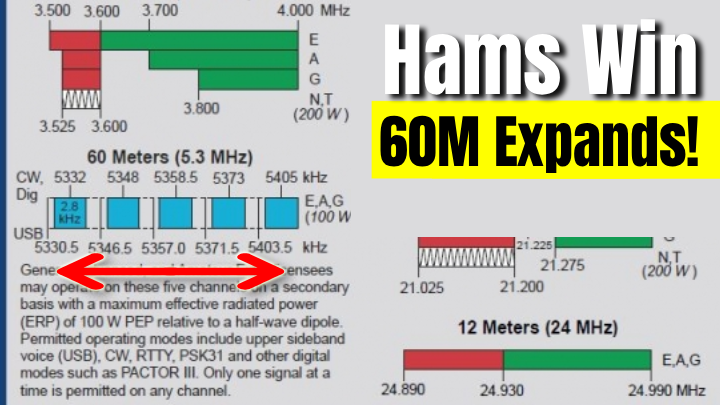
What the FCC just changed on 60 meters
The headline change is the adoption of the international 60 meter band from 5351.5 kHz to 5366.5 kHz. This 15 kHz wide slice becomes available to U.S. amateurs on a secondary basis and lines up with the WRC-15 allocation used in many other Region 2 countries.
Inside this new continuous segment, power is strictly limited to a maximum of 15 watts EIRP, which works out to about 9.15 watts ERP. That cap is part of the international deal and is aimed at protecting primary federal users in the band. The upside is that this space is open to a much wider range of modes, including CW and digital, without the old channel-center constraints.
New 60 meter rules at a glance
| Metric |
Value |
Why it matters |
| New continuous band |
5351.5-5366.5 kHz, 15 W EIRP |
Gives U.S. hams a worldwide compatible 60 m allocation for CW and digital work. |
| Legacy channels kept |
5332, 5348, 5373, 5405 kHz at 100 W ERP |
Preserves proven NVIS and regional coverage for emergency and practical voice operation. |
What stays, what goes on the legacy channels
Many operators were worried that aligning with WRC-15 would mean abandoning the existing U.S. channel plan. Instead, the FCC confirmed that four of the five channels remain:
- 5332 kHz
- 5348 kHz
- 5373 kHz
- 5405 kHz
These channels keep their familiar operating rules:
- Up to 100 watts ERP
- USB voice and authorized digital modes
- Secondary status to federal users
Only one channel is disappearing: 5368 kHz. That frequency lands inside the new 15 kHz allocation, so it cannot remain as a separate discrete channel. In practice, it becomes part of the continuous band segment instead.
A practical summary for your shack
If you just want the quick operational picture, here is how the band now breaks down:
| Segment / Channel |
Frequency |
Power limit |
Typical modes |
Status |
| New continuous band |
5351.5-5366.5 kHz |
15 W EIRP (about 9.15 W ERP) |
CW, digital, narrow SSB |
Secondary to federal users |
| Legacy channel 1 |
5332 kHz |
100 W ERP |
USB voice, limited digital |
Secondary |
| Legacy channel 2 |
5348 kHz |
100 W ERP |
USB voice, limited digital |
Secondary |
| Legacy channel 3 |
5373 kHz |
100 W ERP |
USB voice, limited digital |
Secondary |
| Legacy channel 4 |
5405 kHz |
100 W ERP |
USB voice, limited digital |
Secondary |
| Retired channel |
5368 kHz |
N/A |
N/A |
Removed |
For many operators, especially those who use 60 meters as a go-to NVIS band for local and regional emergency work, keeping 100 watt ERP on the channels is a huge relief. It means your existing antennas, tuners, and emergency playbooks do not get thrown out overnight.
ARRL, NTIA, and the FCC finally line up
The American Radio Relay League has been pushing this compromise for years. In its 2017 Petition for Rulemaking, the ARRL argued that the FCC should adopt the 15 kHz WRC-15 allocation, keep the existing channels that fall outside that slice, and retain higher power on those channels for real world communication needs.
The National Telecommunications and Information Administration, which manages federal spectrum use, also supported the combined approach once it became clear that amateurs have a clean record of coexisting with federal users on 5 MHz. The FCC has now adopted that middle ground and given hams something we rarely get in spectrum debates: more flexibility without losing critical capability.
Why 60 meters matters so much in ugly conditions
The 60 meter band sits in a sweet spot between 80 and 40 meters. It often supports reliable short to medium range communication when other HF bands are noisy, dead, or skewed by solar activity. That makes it a favorite for emergency groups that need regional coverage day and night.
With the new allocation, U.S. operators gain better alignment with stations in other countries that have already been using the WRC-15 band. That is good news for cross-border coordination during hurricanes and large scale emergencies. At the same time, the preserved high power channels keep the band useful for NVIS, regional nets, and solid HF links when 40 and 80 are doing weird things.
How this ruling impacts your station setup
You do not have to rebuild your station from scratch, but you should plan on doing a bit of housekeeping on 60 meters. At a high level, that looks like this:
- Step 1: Check whether your current HF rig already supports the 5351.5-5366.5 kHz segment, or if it needs a firmware update or menu tweak.
- Step 2: Make sure you have a low power profile or operating habit that keeps you under 15 W EIRP when you are in the new continuous band.
- Step 3: Review your emergency and net scripts so they spell out when to use the low power band segment and when to fall back on the 100 W ERP channels.
If you are just getting into HF and want to understand why bands like 60 meters matter so much, take a look at the Getting Started section on Broken Signal for a broader HF overview.
What to do next as a 60 meter operator
Here are some practical moves you can make right now to get ready for the new reality on 60 meters:
- Update band memories in your radios to clearly separate the 15 kHz low power segment from the four 100 W ERP channels.
- Label your station cheat sheets and go kits with both the new band edge frequencies and the surviving channel center frequencies.
- Coordinate with your local ARES, RACES, or club emergency team so everyone is using the same 60 m playbook.
For more context on HF bands and operating strategies, you can also browse the main Radio articles and keep an eye on the News page for any follow up guidance once the rules take effect on the air.
Frequently Asked Questions
What did the FCC actually change on the 60 meter band?
The FCC adopted the international WRC-15 60 meter allocation from 5351.5 to 5366.5 kHz as a continuous band segment limited to 15 watts EIRP, while keeping four legacy U.S. channels at 5332, 5348, 5373, and 5405 kHz with their 100 watt ERP limit. Only the 5368 kHz channel goes away because it falls inside the new band.
What is the new 60 meter band power limit, and how does 15 W EIRP compare to ERP?
Inside the new 5351.5 to 5366.5 kHz allocation, U.S. amateurs are limited to 15 watts EIRP, which is roughly 9.15 watts ERP. EIRP is referenced to an isotropic radiator and ERP is referenced to a half-wave dipole, so an EIRP cap is the slightly stricter of the two for the same antenna.
Which 60 meter channels did U.S. hams keep?
Four of the original five 60 meter channels remain: 5332 kHz, 5348 kHz, 5373 kHz, and 5405 kHz. They keep the long-standing 100 watt ERP limit, secondary status to federal users, and the existing voice and digital mode rules. The retired channel is 5368 kHz, which now falls inside the new continuous WRC-15 segment.
Why did the ARRL push for both a continuous band and the legacy channels?
The ARRL's 2017 Petition for Rulemaking argued that simply replacing the U.S. channel plan with the narrow WRC-15 allocation would have crippled emergency and regional 60 meter operation, which depends on usable power. The combined approach gives operators a globally compatible CW and digital segment plus the higher power voice channels that ARES and RACES groups already rely on.
Why does 60 meters matter so much for emergency communication?
60 meters sits between 80 and 40 meters and tends to support reliable short-to-medium range NVIS coverage day and night, often when the bands above and below are noisy or off. That makes it a backbone band for regional ARES and RACES nets during hurricanes, wildfires, and other disasters where local and state-wide HF traffic has to keep moving.
Do I need to update my radio or antenna for the new 60 meter rules?
Most modern HF rigs already cover 5351.5 to 5366.5 kHz, but some older transceivers may need a firmware update or hidden general-coverage transmit unlocked for the new segment. Antenna-wise, a 60 meter dipole or efficient end-fed already covers the new allocation. The bigger task is rebuilding band memories so the 15 W EIRP segment and the 100 W ERP channels are clearly separate.
The bottom line for 60 meter fans
The FCC has delivered a 60 meter plan that expands flexibility, improves global compatibility, and avoids the feared loss of higher power channels. U.S. hams come out of this with more options, not fewer.
- You gain a continuous worldwide 15 kHz band segment for CW and digital at 15 W EIRP.
- You keep four proven 100 W ERP channels that continue to shine for NVIS and regional voice work.
- You get a band that is better aligned with the rest of the world without sacrificing practical emergency capability.
If you rely on 60 meters for emergency traffic, digital experiments, or just keeping a tough HF link alive when everything else is noisy, this is one of the most ham friendly FCC rulings we have seen in years. Get your station ready now so you are the one everyone can still hear when conditions go sideways.