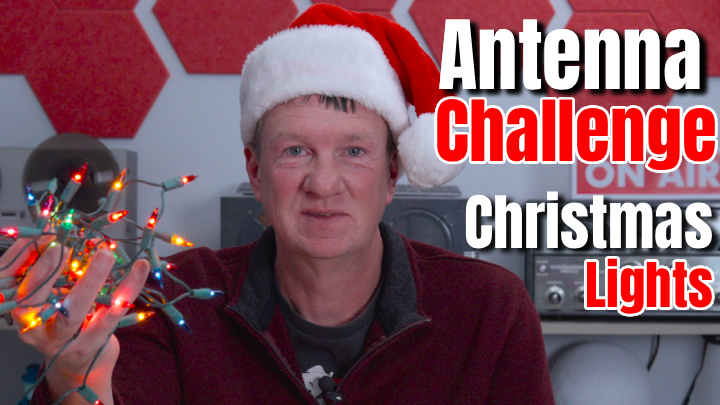
Christmas lights look like a decoration, but to RF they look like what they really are: wire. Lots of it. That means you can turn a cheap strand of holiday lights into a working antenna for HF, and you can do it in a few different ways depending on your yard, your feedpoint options, and whether you have a tuner. This page is a build guide first. The video is just a bonus if you want to see one of the experiments in action.
What counts as "Christmas lights wire"?
We’re not using the lights as lights. We’re using the strand as a wire antenna element. The bulbs and little connections add some loss and weirdness, but they don’t stop it from radiating. If you want the easiest experience, start with a simple, older incandescent mini-light strand (the kind that feels like a long zip cord with bulbs). LED strands can work too, but some have inline controllers, rectifiers, and very thin wire that complicate tuning.
Because this is a seasonal decoration and not purpose-built antenna wire, treat it like an experiment. Use modest power, keep people away from the radiator, and don’t touch the wire while transmitting. If you’re new to HF antennas, spend 10 minutes on Getting Started first. If you want more conventional builds later, bookmark Antennas and Projects.
Safety notes (read this before you hang anything)
Any wire antenna can develop high RF voltages at certain points. Christmas lights don’t magically make that safer. In fact, the bulbs can make the antenna feel "friendly" when it absolutely isn’t. Keep kids, pets, and curious adults away. Keep the antenna away from power lines. Use common sense. If you’re running an amplifier, don’t use Christmas lights for the radiator. This guide assumes low to moderate power (think QRP up to 100 watts, with you being conservative).
Quick "don’t regret this" checklist
| Check |
What to do |
Why it matters |
| Keep it temporary |
Put it up for a test night, then take it down |
Sun, rain, and wind will destroy it faster than real antenna wire. |
| Start low power |
Begin at 5-10 W, verify SWR and stability |
Protects your radio and helps you catch arcing/heat early. |
| Use a choke |
Add a common-mode choke at the feedpoint |
Reduces RF in the shack and makes tuning more repeatable. |
| No contact while TX |
Don’t touch the strand, bulbs, or end insulators |
RF burns are real, especially near voltage peaks. |
Current and voltage on real antennas (why bulb placement can change)
If you’ve never thought about antennas this way, here’s the useful mental model: along an antenna, current and voltage change with position. A classic half-wave wire has high current near the center and high voltage at the ends. That matters because the ends can bite, and it also means you can sometimes get visual effects when you insert bulbs into a section with higher RF voltage.
Important correction for EFHW builds: A resonant half-wave has high voltage at both ends. In an end-fed half-wave system, you’re feeding one end through an impedance transformer, but it’s still an end of the half-wave radiator. That end can be high voltage too. In other words: don’t treat the feedpoint end of an EFHW as "safe" just because it’s near your transformer box.
Tools and materials you’ll use for every build
These builds share the same basic kit. You don’t need everything, but you’ll have a better time if you at least have a way to measure SWR and a way to hang the wire.
- Christmas light strand: Prefer simple, incandescent mini-light strands for the first build. Avoid strands with controller boxes.
- Support gear: Paracord/rope, two or three insulators (or cheap dogbone insulators), and a way to throw a line (throw weight, tennis ball, or a slingshot if you’re careful).
- Feedline: Coax plus a common-mode choke (store-bought or DIY).
- Measuring: Antenna analyzer/VNA is ideal. An SWR meter works if you’re patient.
- Basic hand tools: Cutters, strippers, electrical tape/heat shrink, zip ties.
- Optional but helpful: Ferrite, a notebook for length/tuning notes, and a headlamp if you’re doing this at night.
If you want to see the original experiment that inspired this page, I did a video build and on-air test here (watch after you read, or it’ll derail you):
Pick your build: EFHW, random wire, dipole, or 20m vertical
You can absolutely build all of these from Christmas lights. Choose based on what you have and where you can hang it:
- EFHW: Great when you can get a single long wire up and away, and you have a 49:1 transformer. Often multi-band with the right length.
- Random wire: Great when you have "whatever length fits" and a tuner. A 9:1 unun helps, but isn’t always required if you have a capable tuner.
- Center-fed dipole: Great when you can support the center and want predictable results. This is the easiest to reason about when tuning.
- 20m vertical: Great when you want a simple, single-band radiator and you can lay out radials. Surprisingly effective for its simplicity.
Build #1: EFHW Christmas Lights Antenna (end-fed half-wave)
This is the build most people think of first because it’s a single wire, easy to throw into a tree, and you can get multi-band performance with common EFHW lengths. The big warning is also the big lesson: on a half-wave radiator, both ends can have high RF voltage. That means the transformer box end can still be spicy, and the far end definitely is.
What you need
- 49:1 EFHW transformer (or 64:1, depending on your design)
- Radiator length: A common EFHW length (or whatever length you’re experimenting with)
- Choke: Common-mode choke at the feedpoint (highly recommended)
- Christmas light section: Inserted into the radiator (details below)
Where to put the light strand on an EFHW
If your goal is simply "make contacts with Christmas lights", you can treat the light strand as part of the radiator length and place it anywhere that’s convenient. If your goal is "see where RF voltage is high" (bulbs glowing, uneven brightness), you’ll usually get more of that effect closer to an end of the half-wave, not in the middle.
In my experiment, I placed a 50-light section about 8 feet back from the far end of the wire to push it closer to a voltage-heavy area. That’s a fun trick for visual effect, but it’s not a magic number. Your frequency, your length, the strand construction, and your nearby objects all change the result.
Step-by-step EFHW build
- Decide your EFHW length: Use the EFHW length you already run successfully, or pick a known starting point you can tune from. Don’t overthink the "perfect" length on day one. Your goal is a working experiment.
- Prepare the lights: Remove any controller box and power plug assembly. You want the simplest "wire with bulbs" section you can get. If the strand is a sealed LED system with a bulky inline module, pick a different strand.
- Insert the light strand into the radiator: Cut your radiator at the point where you want the light section to live. Splice the light strand in-line so the strand becomes part of the radiator. Use a mechanically solid connection (twist + solder if you can) and weather-protect it with tape/heat shrink.
- Add strain relief: Don’t let the splice carry the load. Use rope and insulators so tension is on rope, not copper or the bulb sockets.
- Mount the transformer safely: Put the transformer in a weather-resistant box if you’re outside, and mount it so nobody can touch it while transmitting.
- Add the choke: Put your common-mode choke right at (or very near) the transformer output / feedpoint area.
- Hang the radiator: Get it up and away from metal. Keep the last few feet away from tree trunks if you can; wet wood changes things.
- Tune and test: Check SWR on the band you care about first. If SWR is ugly, adjust overall length a little at a time, or use a small tail section you can fold back. Don’t cut a foot at a time and then regret it.
- Operate and log: Make a few contacts. If you’re testing "does this work", FT8 or other digital modes can be a fast proof. Then try SSB/CW if you want to really feel it.
EFHW troubleshooting notes
- RF in the shack? Add or improve the choke, shorten the feedline run inside the house, and keep the feedpoint away from your operating position.
- SWR changes when you touch coax? That’s a common-mode issue. Choke it harder.
- Bulbs glow in weird spots? Totally normal. Bulbs are not calibrated RF meters, and the strand construction creates discontinuities.
Build #2: Random Wire Christmas Lights Antenna (with tuner)
If you want the fastest path to "I made contacts with Christmas lights," this is it. Random wire plus a tuner is forgiving. You can use whatever length you can fit, and the tuner does the heavy lifting. A 9:1 unun can help the tuner see a friendlier impedance, but the tuner is the real hero here.
What you need
- Tuner: Internal tuner or external tuner (external is usually better)
- Optional 9:1 unun: Helps with matching on many random wire setups
- Counterpoise or radials: Even a simple counterpoise wire can stabilize tuning
- Christmas light strand: Used as all or part of the radiator
Step-by-step random wire build
- Pick a length you can hang: Don’t chase a magical number. Pick a length that fits your yard and supports. Longer usually helps, but too close to the ground or wrapped around stuff can hurt more than it helps.
- Decide how the lights fit: Option A: Use the Christmas light strand as the whole radiator. Option B: Use it as a section of a longer radiator (recommended if your strand wire is thin).
- Build the feedpoint: If using a 9:1 unun, connect the wire to the unun output, coax to the unun input, then add a choke on the coax. If feeding directly to a tuner, keep coax short and still use a choke where it makes sense.
- Add a counterpoise: Start with a quarter-wave-ish wire for the band you care about, or just put 10-30 feet of wire on the ground as a starting point. It doesn’t have to be perfect to be useful.
- Hang the wire: Get the radiator away from the house if you can. Inverted-L works great if you can’t do a full sloper.
- Tune at low power: Always tune on low power. Once the tuner finds a match, slowly bring power up.
- Confirm it’s radiating: Make contacts, compare reports, and try another band. This is where random wire shines.
Random wire tips that save you time
- If the tuner won’t tune: Add or change the counterpoise length, move the feedpoint away from metal, and check your connections. The strand’s bulb sockets can hide a bad joint.
- If it tunes but performs poorly: Get it higher, move it farther from the house, and add a better choke.
- If your light strand is fragile: Use it as a middle section and splice real wire to each end so tension is not on the bulbs.
Build #3: Center-Fed Dipole with Christmas Lights
If you want the most "textbook" approach, do a dipole. It’s easy to understand, easy to troubleshoot, and you can mix materials: one leg can be lights, the other leg can be normal wire, or both legs can be lights. A dipole is also a great way to illustrate that the ends of the dipole are high voltage points, which is another reason to keep hands away.
What you need
- Center insulator: A center connector with an SO-239, or a DIY center plate
- Balun: 1:1 current balun is recommended (especially to reduce common-mode)
- Two legs: Either two light strands, or one light strand + one wire leg
- Rope and end insulators: Don’t hang by the bulb sockets
Step-by-step dipole build
- Pick your target band: Start with one band (like 40m or 20m). Multi-band dipoles are possible, but don’t make your first build harder than it needs to be.
- Cut two equal legs: Use the light strand as the leg material, or splice it into each leg. If you’re worried about strength, splice the light strand in as a middle section and use normal wire near the ends.
- Build the center feed: Connect one leg to each side of the balun/center. Make sure you have good electrical contact, then strain-relieve the legs so the connectors aren’t carrying weight.
- Hang the dipole: Put the center high if you can. Even a simple inverted-V works great if you only have one high support.
- Trim for resonance: Measure SWR near the band center and trim both ends equally. Small cuts. Measure again. Repeat.
- Operate: After it’s tuned, run the mode you like and compare it to a known antenna if you have one.
Dipole troubleshooting notes
- If the resonant point is low: Shorten both legs equally.
- If the resonant point is high: Lengthen both legs (folding the last bit back is an easy way to "add length" without splicing).
- If SWR is weird across the band: Check for a bad connection at a splice or bulb socket, and verify your balun is good.
Build #4: A Simple 20m Vertical Using Christmas Lights
A 20m vertical is a great "one band, simple parts" antenna, and it’s a solid use for a light strand because you can build it as a radiator plus a handful of radials. The key is radials. You can have the prettiest vertical on earth, but with no radials, it’s mostly pain and disappointment.
What you need
- Radiator: A quarter-wave-ish vertical element for 20m (use the light strand as the radiator, or splice it into a stronger wire)
- Feedpoint: Simple vertical feed at the base (coax + choke recommended)
- Radials: At least 4. More is better. Even short radials help.
- Support: A fiberglass mast, painter pole, or a tree branch if you’re careful
Step-by-step 20m vertical build
- Build the radiator: Use a section of Christmas lights as the vertical element. If the strand is flimsy, tape it to a fiberglass pole or run it alongside a stronger wire for mechanical support (still electrically connected at the base).
- Make the base feed: Connect the radiator to the coax center conductor at the base. Connect radials to the coax shield side. Use a proper connector or a simple terminal plate. Keep it neat.
- Lay out radials: Start with 4 radials and spread them like spokes. Add more if you can. If you’re on a tiny lot, shorter radials are better than none.
- Add a choke: Put a choke on the coax a short distance from the feedpoint to keep the feedline from becoming part of the antenna.
- Trim and tune: Check SWR on 20m and adjust radiator length slightly. This is usually easier than EFHW tuning because you’re mostly adjusting one element.
- Operate and compare: Try a few QSOs. Then try changing the radial count. You’ll learn more from that than from another hour of forum reading.
Performance expectations and why this is still worth doing
Let’s be honest: Christmas lights are not low-loss antenna wire. You’re adding resistance and discontinuities. But "not optimal" does not mean "doesn’t work." The goal is to learn, to test, and to get on the air with something fun. If you want a more durable DIY option after this, use the same designs with proper wire and hardware and you’ll keep most of the knowledge, minus the seasonal novelty.
Build comparison (quick decision table)
| Antenna type |
Best use |
Needs a tuner? |
| EFHW (49:1) |
Single support, multi-band experiments |
Optional (often helpful) |
| Random wire |
Fastest "it works" build, odd yard lengths |
Yes (recommended) |
| Center-fed dipole |
Predictable tuning, clean feedpoint behavior |
No (for single-band) |
| 20m vertical |
Simple single-band, great with radials |
No (if tuned), maybe (if not) |
Practical operating tips
Once you’re tuned and stable, make the test meaningful. Don’t just key up and say "yep, SWR is good." Put it on the air. Try a few different modes. Log your results. If you want fast proof, digital modes make it easy. If you want the full ham experience, call CQ and see who comes back.
- Log a baseline: If you have a known antenna, make a few contacts on that first, then switch to the Christmas lights antenna.
- Change one thing at a time: Move height, change radial count, add a choke, then test again. That’s how you learn.
- Don’t chase perfection: The point is to understand behavior and make contacts, not to build the world’s best light-strand antenna.
Frequently Asked Questions
Do LED Christmas lights work as an antenna?
Sometimes, but results are less predictable. Many LED strings include controllers or extra electronics and use thinner wire than older incandescent strands. Simple incandescent-style strings are usually easier to tune and behave more like ordinary antenna wire on HF.
Is an EFHW high voltage at the feedpoint end too?
Yes. A resonant half-wave wire has high voltage at both ends. Even though an EFHW uses a transformer at one end, that end can still be a high-voltage point. Keep distance and use safe mounting around the entire run, including the matchbox.
Will RF actually make the bulbs glow?
It can. Some strands show a visible glow depending on frequency, power, placement along the antenna, and the strand's construction. It is fun, and it can hint at where current and voltage live, but do not treat glowing bulbs as an accurate measurement tool.
Do I need radials for the 20m vertical version?
Yes. A vertical needs a return path. Even a few radials help a lot, and more radials typically improves efficiency, lowers ground loss, and stabilizes the SWR across band conditions. Treat the radial system as part of the antenna, not an optional accessory.
What mode is best for testing a Christmas lights antenna?
Digital modes like FT8 are great for proving the antenna works at low power because reports come back with SNR data and you do not need to find a willing live operator. Once tuning looks stable, CW and SSB are perfectly fine for everyday use.
How much power can I run into a Christmas light antenna?
Treat it as a low-to-moderate power experiment. QRP through about 100 watts is reasonable on a clean strand without inline electronics, and you should watch for heat or arcing at sockets and splices. Do not feed an amplifier into Christmas lights — the thin wire and lossy connections will burn up long before they radiate that power cleanly.
So... should you build antennas from Christmas lights?
Yes, as long as you treat it like an experiment and keep it safe. Christmas lights make a surprisingly good "RF teaching tool" because they force you to think about where voltage and current live, how feedlines misbehave, and why height and surroundings matter.
- Want the classic challenge build? Start with an EFHW, but remember: high voltage can exist at both ends.
- Want the easiest first success? Do a random wire with a tuner and a simple counterpoise.
- Want the cleanest tuning process? Build a center-fed dipole and trim it like a normal dipole.
- Want a strong single-band option? Try the 20m vertical and focus on radials.
Build one, make a few contacts, and then tell me what you’d do differently. If you want more builds like this, dig through Antennas and Projects and pick your next challenge.