If you ask ten hams how high a dipole should be, you'll probably get twelve answers. Some guys insist anything under half a wavelength is a waste of wire. Others work solid DX with a droopy span of copper barely clearing the fence. The truth sits in the middle, and it depends on the bands you care about, the contacts you want to make, and what your yard and supports will realistically allow. This guide boils height down into practical targets so you can hang a dipole that fits your space and still gets the job done.
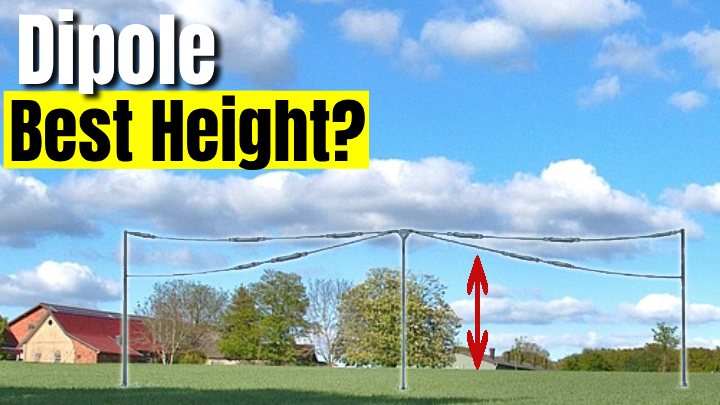
Before you start crunching wavelength math, remember this. The best dipole height is the height you can actually build without doing something sketchy. A 40 meter half wave at 66 feet looks great on paper, but a lot of hams don’t have the supports, budget, or patience to make that happen. Instead of obsessing over the perfect number, think in bands. Low, medium, and high relative to wavelength. That way of thinking makes it much easier to pick a height that works in your yard.
Height also interacts with the ground under the antenna, soil conductivity, nearby houses, and even how much sag is in the wire. A low horizontal dipole on 80 meters works extremely well as an NVIS antenna, filling in the 50 to 400 mile range. Put that same antenna at the same height on 20 meters and the behavior changes completely. As you read, keep your main band and target distance in mind. Are you building for local nets, regional emergency coverage, or chasing DX on the other side of the planet? That answer tells you how hard it’s worth pushing for more height.
The short answer: half a wavelength is a great goal
If you want a simple rule of thumb, this is it. For a horizontal HF dipole, about half a wavelength of height is a solid all around target. At that point the main lobe drops to a more DX friendly angle, sidelobes behave themselves, and the antenna still performs well on the band it’s cut for. Getting a full wavelength up improves long haul work even more, but that usually means towers or ridiculous trees, which puts it out of reach for most home stations.
Typical dipole heights and what they are good for
| Metric |
Value |
Why It Matters |
| Backyard friendly height (most HF bands) |
0.15 - 0.25 wavelength (about 15 - 30 ft on 40 m) |
Easy to reach, great for regional contacts and NVIS on lower bands, and still usable for casual DX when conditions cooperate. |
| DX focused height goal |
0.5 - 1 wavelength above ground |
Lowers the main takeoff angle, which strengthens long hop and multi hop paths, especially on 40 and 20 meters. |
Turning wavelength into real world dipole heights
Talking in fractions of a wavelength sounds nice until you’re standing in the yard holding a tape measure and a coil of wire. Then you need real numbers. Start by deciding which band actually matters most to you. For a lot of stations, that’s 40 meters, with 80 meters close behind for nighttime work.
Once you’ve picked the band, look up the wavelength and do the quick math. Forty meters comes out to about 131 feet, which puts half a wavelength right around 66 feet. Raise the dipole as close to that height as you safely can, then stop worrying about it and start making contacts. Chasing the last few feet rarely moves the needle as much as getting on the air.
Here are some easy numbers worth memorizing. On 80 meters, a half wavelength is roughly 130 feet. On 40 meters, it’s about 66 feet. On 20 meters, it drops to around 33 feet. Most of us aren’t getting an 80 or 40 meter dipole up at a true half wave, but hitting that neighborhood on 20 meters is very doable with a decent mast, a roof mount, or a cooperative tree. And if most of your operating is ragchewing or traffic handling on 80 and 40, a lower height actually helps by pushing more energy straight up for NVIS.
If you’re still getting your feet wet with antennas and HF propagation, it’s worth skimming the general antennas section or the getting started page on Broken Signal. Height is only one piece of the puzzle, but once you see how it shapes your radiation pattern, the rest of your station planning clicks into place.
Low vs high dipoles: NVIS, local work, and DX
Instead of arguing over one magic height, it helps to think in zones. Each zone favors a different style of operating, and none of them are wrong if they match your goals.
A low dipole, under about 0.2 wavelength, is the classic backyard 80 or 40 meter antenna sitting 15 to 25 feet up. It produces a strong high angle lobe that shines for NVIS and regional coverage. That makes it excellent for emergency communications and local nets, even though it won’t be a DX monster.
A medium height dipole, in the 0.25 to 0.5 wavelength range, is the compromise most home stations land on. You still get plenty of high angle energy for nearby stations, but the main lobe starts tipping lower, so longer paths open up. This is where one antenna can cover a lot of operating styles reasonably well.
Once you’re at half a wavelength or higher, the pattern clearly favors DX. Low angle radiation gets stronger, and long distance contacts get easier. On 20 meters this is achievable for a lot of hams. On 80 meters, it usually means towers or very tall trees.
How height changes takeoff angle and pattern
The whole reason height matters comes down to takeoff angle, which is the angle above the horizon where your antenna sends most of its energy. HF signals launched at low angles travel farther because they spend more time bouncing between the ionosphere and the earth before fading out. A dipole that’s very close to the ground acts like a big warm light bulb hanging over your shack, lighting up everything nearby but not throwing much light past the hills.
As you raise the antenna, that high angle lobe shrinks and lower angle lobes start to dominate. On bands like 20 meters, getting a dipole up even 25 or 30 feet changes how often you’re heard across an ocean. You can model this all day long in software, but the real world takeaway is simple. For DX, more height is better, as long as you’re staying safe and following the rules.
Practical mounting options for real backyards
Knowing that half a wavelength is a nice target doesn’t magically put a 70 foot tree in your yard. The good news is that you have more options than you might think. With trees, house mounts, and a little creativity with masts, you can usually get a dipole high enough to perform very well, even on a small lot.
An inverted V is often the easiest win when supports are limited. You get the center up high on a single mast and let the ends slope down, which reduces stress and keeps the wire out of the way. It also helps to prioritize clear sky and symmetry over squeezing out one more foot of height. Keeping both legs reasonably level and away from gutters, metal roofs, and power lines improves performance more than that last bit of altitude.
And don’t ignore safety and stealth. Keep wire well clear of AC lines, use visible end insulators where people might walk, and consider sloping the last few feet up or down so it’s out of reach.
Frequently Asked Questions
Is a low dipole always bad for HF?
Not even close. A low dipole on 80 or 40 meters makes a fantastic NVIS antenna for in-state and regional work. You won't dominate rare DX pileups, but you'll be rock solid on local emergency nets. As long as you know what you built it for, a low dipole is doing exactly what it should.
Do I need exactly half a wavelength of height?
No. Half a wavelength is just a convenient target that gives a good balance of takeoff angle and pattern. If your dipole ends up a few feet lower than the math says, nothing breaks. Get it as high and as clear as you safely can, then judge it by real signal reports, not a calculator.
Is it worth using an inverted V to gain center height?
For most home stations, absolutely. Turning a flat dipole into an inverted V often buys you 5 to 15 extra feet of center height using the same supports. The pattern becomes more omnidirectional and the feedpoint is easier to keep away from power lines. Keep the angle between the legs wider than about 90 degrees if you can.
How does dipole height change my takeoff angle?
Lower dipoles send most of their energy nearly straight up, which produces a high takeoff angle that is great for NVIS and regional contacts but poor for DX. As the antenna climbs above roughly a quarter wavelength, the high-angle lobe shrinks and lower-angle lobes grow. By half a wavelength, the main lobe sits in a DX-friendly range, and at a full wavelength the pattern is fully tipped toward long-haul work.
What is a practical dipole height for an 80m or 40m wire on a small lot?
For most suburban yards with normal trees and a single mast, plan on roughly 25 to 35 feet of center height. That keeps the wire above heads and metal roofs, gives you a strong NVIS pattern on 80 and 40, and still works fine for casual DX. Pushing the antenna higher always helps, but you do not have to hit the textbook half-wave on the lowest band to make solid contacts.
Does ground type matter as much as height for a dipole?
It matters, but height usually wins. Soil moisture and conductivity slightly shift the impedance and pattern of a low dipole, especially under a wire that sits a fraction of a wavelength above ground. Above about half a wavelength, the antenna mostly stops caring about the dirt below it. Lifting the wire is almost always a bigger improvement than tweaking what is under it.
So how high should your dipole be?
If you can get your main HF dipole up around half a wavelength on its primary band, you’ll have a very capable antenna. If you can’t, that’s fine. Plenty of hams work the world every day with wire sitting at 20 or 30 feet, especially on 40 and 80 meters where lower heights naturally favor NVIS and closer contacts.
Aim for about half a wavelength when it’s realistic, but don’t let that number keep you off the air. Think in terms of operating goals. Low for NVIS and regional work, medium for mixed use, and higher when DX is the main priority. Use practical mounting tricks like inverted V layouts, trees, and roof mounts to squeeze the most safe, clear height out of your yard.
If you’re planning a new station or reworking your current wire farm, sketch the lot, pick a height you can actually build, and start tying off rope. Once the dipole is in the air, spend time on the bands and let real signal reports guide the next tweak. When you’re ready for another project, the projects section on Broken Signal has plenty more antenna ideas to play with.