If you want serious HF gain but you do not want a tower and big aluminum beam, a V beam antenna is a fun middle ground. With nothing more than wire, a couple of tall supports, and some planning, you can build a directional HF antenna that really digs weak DX out of the noise and favors one part of the world over the rest.
A V beam is basically two long wires, fed at the open end and pointed at your target. Because the legs are several wavelengths long and separated by a shallow angle, you get a strong main lobe along the bisector of the V and a nice drop in signal off the back and sides.
This guide walks through planning, sizing, building, and tuning a practical HF V beam for a typical ham property. If you are brand new to HF antennas, you may want to skim the general antennas section first, but you do not need to be an RF engineer to build this and get good results.
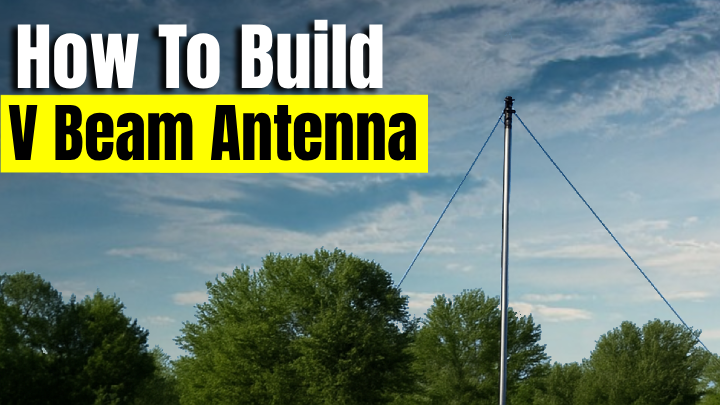
What is a V beam antenna and when does it make sense?
A V beam is part of the family of long wire directional antennas. Instead of a single long wire, you run two equal length wires that form a wide V. The feedpoint is at the open end where the two legs are close together. The main lobe points toward the open area inside the V, roughly bisecting the angle between the legs.
Typical V beam dimensions for HF bands
| Metric |
Value |
Why It Matters |
| Leg length on 20 meters |
2 to 3 wavelengths (30 to 45 m per leg) |
Longer legs sharpen the main lobe and increase forward gain at the design band. |
| Included angle |
60 to 120 degrees |
Smaller angles give narrower, higher gain beams; wider angles broaden coverage but reduce gain. |
Planning your V beam build
Before you cut wire, decide what problem you are trying to solve. Do you want to improve your signal to Europe on 20 meters from the US east coast, or work VK and ZL from the midwest on 40 meters? Pick one or two primary paths and design the V beam around them. Use an online Azimuthal Map to find the heading from your station to that part of the world, then sketch the V so the center of the opening points that way.
- Step 1: Choose your primary band and DX target, then estimate how much room you have for each leg.
- Step 2: Decide where the feedpoint will be and where you can place the far ends, using trees, masts, or poles.
- Step 3: Work out approximate leg length and angle, making sure you can safely clear power lines, roofs, and neighbors.
V beam vs other HF wire antennas
Most hams start with a simple dipole or off center fed wire and never move past it. A V beam sits somewhere between those basic antennas and a full blown Yagi. It is bigger and more directional than a dipole, but much cheaper and easier to install than a tower mounted beam.
- Compared to a dipole, a V beam can offer several dB of forward gain and improved front to back response in its favored direction.
- Compared to a random long wire, the V beam pattern is easier to control and repeat, and the main lobe is more focused.
- Compared to a Yagi or hexbeam, the V beam needs more real estate but far less hardware, and there is no rotator to maintain.
On air performance and what to expect
A well built V beam on 20 meters, two to three wavelengths per leg and at a decent height, can give forward gain in the neighborhood of 6 to 9 dB over a reference dipole in the favored direction. That translates to roughly one to one and a half S units at the other end, often the difference between barely heard and easy copy.
Pattern wise, expect a strong, fairly narrow main lobe along the opening of the V, some weaker side lobes, and noticeably less signal off the back. For rag chewing in every direction, this is not ideal, but for chasing DX or focusing on a specific region it is a lot of fun. You will quickly get a feel for where the nulls are as you spin the dial and see who you do and do not hear compared to your other HF antennas.
Practical building tips and tuning steps
Think of the V beam as a permanent field day antenna. It rewards careful layout, but it is also forgiving. Here is a simple, repeatable way to get one on the air without turning your yard into a spiderweb of tangled wire.
- Lay out the legs on the ground first. Measure and mark the leg length you want on the ground using stakes or flags. For a 20 meter V beam, something around 35 meters per leg is a good starting place if you have the room.
- Set your supports and insulators. Put a good end insulator at each far end, then run rope over branches or through mast pulleys so the wire can flex without sawing through trees. Keep the feedpoint end at a comfortable working height for future maintenance.
- Install the feed and matching network. Many hams use a 4 to 1 current balun at the feedpoint, then run coax back to the shack and use a tuner at the rig. If you prefer balanced line, route it away from metal and use a tuner designed for ladder line.
Frequently Asked Questions
Do both legs of a V beam need to be exactly the same length?
Yes, keep the legs as close to equal as you reasonably can. Small differences will not kill the antenna, but big mismatches can distort the pattern and shift the main lobe. Measure carefully during the layout step and trim both legs together if you need to shorten things.
What height should I aim for at the feedpoint and far ends?
Higher is almost always better for DX. On 20 meters, a feedpoint around 40 feet with far ends at 50 to 70 feet works very well if you can manage it. On lower bands like 40 meters, you may not reach a full half wavelength in height, but even 40 feet will still give useful low angle radiation, especially if your ground is not terrible.
Can I use the V beam on multiple bands?
You can often operate a V beam on harmonic bands with a good tuner, just like many other long wire antennas. The pattern will get more complex and you may pick up extra lobes, but it can still be useful. If you want a more predictable pattern on several bands, consider pairing the V beam with a more general multiband wire described in other radio articles on Broken Signal.
What happens if I cannot get the ideal V angle?
If obstacles force you into a wide or crooked V, the antenna will still work, just with slightly different gain and coverage. A very wide V starts to look more like two separate long wires, while a very narrow V concentrates more power in a tighter main lobe. Do the best you can with your space and supports, keep it safe, and then see how it actually plays on the air.
How high should a V beam antenna be for HF?
Aim to get the V beam legs at least a half wavelength high on the band you care about, with one wavelength or more height preferred for low-angle DX. In practice, 40 to 70 feet is common for 40 and 20 meters in a typical yard.
Can I run legal limit power into a V beam antenna?
Yes, a V beam built with quality wire, good insulators, and a balun or matching unit rated for the power level can handle legal limit RF. Maintain generous spacing from trees and structures and keep the feedline and components within their rated power and voltage limits.
Is a V Beam Antenna Right for Your Station?
If you have the horizontal space for two long wires and at least a couple of tall supports, a V beam is one of the cheapest ways to add real directional gain to your HF setup. It will not replace every antenna at your station, but it can become your favorite when conditions line up with its main lobe.
- A V beam gives you focused HF DX performance using simple wire and hardware you can build in a weekend.
- Pattern and performance improve as you increase leg length and height, so plan around the best supports you can safely use.
- Pair the V beam with a basic dipole or vertical so you have both all-around coverage and a strong DX tool.
If this build sounds like a good fit, sketch your property, pick a heading, and start planning where those two long legs can live. Then grab some wire, check your local rules, and turn your yard into a quiet, directional HF listening and transmitting machine.
If you enjoy this kind of DIY antenna work, keep an eye on the projects section for more HF builds you can combine with your new V beam.