📌 TL;DR — Pick the network model first
- Core idea: Meshtastic favors a flexible, ad-hoc mesh; MeshCore favors a more managed mesh with defined roles.
- Why it matters: Your routing style determines airtime, battery life, and whether the network behaves under load.
- Key benefit: Meshtastic is great for "show up and it works" groups; MeshCore can be cleaner for fixed infrastructure networks.
- Who it’s for: Hikers and casual groups usually land on Meshtastic; builders planning repeaters and coverage tend to like MeshCore.
If you're building an off-grid LoRa mesh, MeshCore and Meshtastic can look like the same idea from 30,000 feet: small radios, phone (or handheld) messaging, and multi-hop range when terrain and placement cooperate. The real differences show up once you try to scale past a few friends in a parking lot. This comparison is aimed at practical decisions: which one is easier to deploy for a hike, which one holds together under emergency-style traffic, and which one makes more sense when you want reliable rural coverage.
One quick framing that helps: Meshtastic feels like a general-purpose "people mesh" with strong mobile apps and a huge user base. MeshCore feels like a "network builder" approach that can be lighter on the air when you design the topology on purpose. Neither is universally better. They just reward different habits.
If you're brand new to LoRa mesh in general, start with our Meshtastic section for the basics (hardware picks, channel settings, and common mistakes). If you already run nodes, keep reading. We'll stay focused on what changes your results in the field.
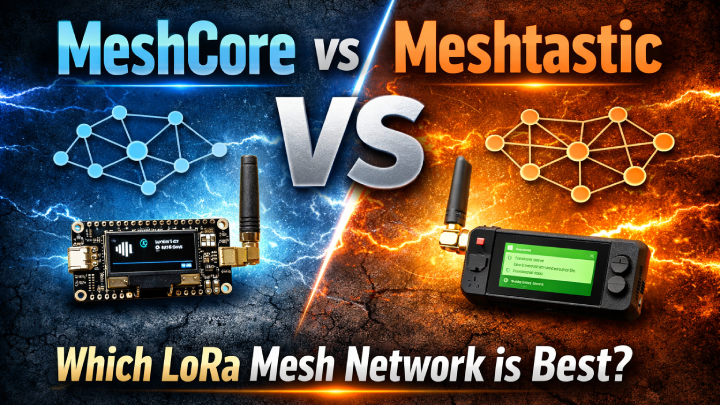
How the two projects think about the mesh
Meshtastic is built around the idea that any node might need to help relay, and that the network should still function when nodes appear and disappear. That fits real life: hikers spread out, vehicles move, and battery packs die. The tradeoff is airtime. Flooding-style behavior (even when tuned) can mean more redundant packets when the mesh gets busy or dense.
MeshCore leans toward a more deliberate topology. In simple terms, it can behave more like "clients talk through relays" when you set it up that way. The benefit is that you can avoid every pocket node acting like a repeater. The tradeoff is planning: you will get the best results when you decide where relays live, how power is handled, and what roles nodes should play.
Neither approach violates physics. You're still living inside LoRa's tiny bandwidth. Your best "performance upgrade" is always antenna height, line of sight, and smart placement. The software just decides how expensive each message is in airtime and battery.
Side-by-side: what you feel day one
| Metric |
Value |
Why It Matters |
| Setup speed for a small group |
Meshtastic usually wins |
Phone apps and community defaults make it easy to get 4-10 nodes chatting fast. |
| Scaling to a planned coverage network |
MeshCore often wins |
Dedicated relays and clearer roles can reduce chatter and keep traffic predictable. |
Quick-start decision steps (the 3 questions that pick for you)
You can save yourself a weekend by answering these in order. Don't overthink it. Pick the one that matches your actual use case, not the one that sounds cooler on paper.
- Step 1: Are you joining an existing local mesh? If yes, use what they use (almost always Meshtastic). Compatibility is the whole game.
- Step 2: Is this a pop-up network with moving users (hike, event, convoy)? If yes, default to Meshtastic unless you know you want managed relay roles.
- Step 3: Are you building fixed coverage with a few high sites (farm, valley, neighborhood, shelter comms)? If yes, seriously consider MeshCore and plan relays first.
Feature comparison that actually matters in the field
Most feature lists look impressive and tell you almost nothing about success rates. The features that matter are the ones tied to airtime, routing behavior, and how clients behave when a node drops out.
- Clients and UI: Meshtastic has mature Android and iOS apps and a big user community. MeshCore can be great if you want phone-free options (a keyboard device or a more "appliance" feel), but your experience depends more on the specific client you pick.
- Roles and topology: Meshtastic can be tuned, but it generally rewards "let nodes participate." MeshCore rewards intentional placement with dedicated relays so not every pocket device is burning airtime.
- Store-and-forward expectations: If you want message history or more managed delivery, MeshCore-style architectures can feel more reliable in practice. Meshtastic is excellent for real-time messaging when the mesh is healthy and not overloaded.
Performance: range is mostly antennas, but routing changes the pain
Raw range is the wrong metric unless you're testing with the same antennas, height, terrain, and settings. In real deployments, the performance question is: "How many messages make it through when people are moving, and how ugly does it get when the mesh gets busy?"
Meshtastic can look incredible when the mesh is sparse and nodes are well-placed. It can also get chatty in dense areas if people run default settings and every node decides it should rebroadcast everything. If you're doing an event or a busy neighborhood, you will want to learn the airtime knobs. That includes limiting hops, tuning rebroadcast behavior, and being realistic about location beacons.
MeshCore can feel calmer on-air when you build around relays. The downside is obvious: if your relay coverage is weak, clients can end up isolated more often. It's the classic trade: ad-hoc resilience vs planned efficiency. If you're the person willing to mount two good relays and keep them powered, MeshCore can pay you back with a network that stays usable when traffic rises.
Use cases: hiking, emergency comms, rural networks
Here's where the decision usually becomes clear. Pick the column that matches your reality.
Hiking and backcountry groups
Best default: Meshtastic. Hikes are messy: people separate, regroup, turn around, and forget to charge things. Meshtastic's "ad-hoc first" mindset fits that. You can hand someone a node, pair their phone, and they're in.
When MeshCore makes sense: If you hike the same area a lot and you can place one or two semi-permanent relays (a ridge cabin, a parked vehicle at the trailhead, or a high point with solar), MeshCore can be attractive. It turns your hike into "clients plus infrastructure" instead of hoping the chain of hikers stays spaced perfectly.
Emergency comms and community readiness
Best default: It depends on who is running it. If you want something volunteers can adopt quickly with minimal training, Meshtastic tends to win. The moment you scale beyond a handful of trained operators, the user experience matters as much as RF performance.
When MeshCore wins: If you have a team that will actually maintain the network, a managed relay design can be a big deal. In emergencies, congestion is the silent killer. People spam "test test" and location beacons. A topology that reduces unnecessary relays can keep the network usable longer.
If you're building emergency capability, also think about what happens after the "cool demo." Document your channel settings, labeling, and charging plan. Put it in a binder. Seriously.
Rural networks and fixed coverage
Best default: MeshCore, if you can place relays well. Rural meshes are usually about coverage, not "everyone at the farmers market texting." A few good sites matter more than lots of pocket nodes.
When Meshtastic is still the right call: If you want to plug into a broader ecosystem or you expect a lot of casual users to join, Meshtastic's installed base is a real advantage. You can still run a rural Meshtastic network successfully, but you will want to treat airtime as a limited resource and tune your nodes accordingly.
Pros and cons: the honest version
Here's the practical trade list. Not the marketing list.
| Category |
Meshtastic |
MeshCore |
| Best at |
Ad-hoc groups, quick setup, joining existing communities |
Planned networks with defined relay roles and predictable behavior |
| Common failure mode |
Congestion when too many nodes rebroadcast too much |
Coverage gaps if relays are missing or poorly placed |
| Learning curve |
Easy to start, takes effort to optimize |
More planning up front, smoother once designed |
| Great for |
Hikes, events, casual off-grid texting |
Neighborhood coverage, rural links, fixed emergency infrastructure |
Practical tips that improve either network
This stuff makes a way bigger difference than arguing about firmware. Do these and you'll feel like you upgraded your radios. First off, get one antenna high—a single node at roofline or on a ridge can outperform ten nodes at waist height. Even a basic outdoor antenna with a short, quality feedline changes everything. Next, treat airtime like money.
Cut unnecessary beacons, slow down location updates, and don't run "chatty" defaults in dense areas. LoRa is absolutely not Wi-Fi. Finally, standardize your settings. Make a simple one-page cheat sheet with your frequency region, channel name, modem preset, and hop limit written down. Your future self will be grateful.
When to choose MeshCore over Meshtastic
If you're looking for the cleanest line in the sand, here it is: choose MeshCore when you want to build a network, not just join one. That usually means you can place dedicated relay nodes, you can keep them powered, and you care about consistent behavior under load.
Choose MeshCore if at least two of these are true:
- You can place a relay on a known high site (or two sites that can see each other).
- You want pocket nodes to behave like clients instead of accidental repeaters.
- You expect more traffic than "a few messages an hour" and you want the mesh to stay usable.
- You like building infrastructure and you are okay owning the maintenance plan.
When Meshtastic is the right answer
Meshtastic is the right answer when the network is mostly people and phones. If you want to hand a node to a friend and have them texting in 5 minutes, that's Meshtastic's home turf. It's also the right choice when your local community already runs it. Mesh networks are social as much as technical. If your town already has a Meshtastic mesh, that matters more than any feature checklist.
Meshtastic is also a great sandbox. You can start with two nodes, learn how the knobs affect airtime, and later decide if you want to build a more structured network. Nothing is wasted learning.
So which should you run?
If you want fast adoption, flexible ad-hoc behavior, and easy onboarding for normal humans, Meshtastic is still the default pick. If you want a calmer, more planned mesh where dedicated relays do the heavy lifting, MeshCore deserves serious consideration.
- Pick Meshtastic for hiking groups, events, and joining existing meshes.
- Pick MeshCore for fixed coverage, rural infrastructure, and managed emergency networks.
- Either way, spend your effort on antenna height, power reliability, and sane airtime settings.
Ready to build your own LoRa mesh?
Whether you're going with Meshtastic or MeshCore, you'll need the right hardware to get started. Check out LoRa mesh devices and accessories to find nodes, antennas, and everything else you need to get your network up and running. The sooner you get your hands on the gear, the sooner you can start experimenting and see what works best for your setup.
Frequently Asked Questions
Can MeshCore and Meshtastic nodes talk to each other?
No. They are different protocols with different routing and packet formats. You can run both networks in the same area on different channel settings, but they are not interoperable.
Which one is better for a pop-up hiking group?
Meshtastic is usually the easier win for ad-hoc groups because the phone apps are mature and the network model works well for quick setup. If you want a more managed network with dedicated relay roles, MeshCore can be a better fit.
Which one is better for a fixed rural coverage network?
MeshCore tends to shine when you can place dedicated relays or repeaters in known locations and keep the network topology more controlled. Meshtastic can work too, but you will want to tune rebroadcast and airtime settings to avoid congestion.
Do both support encryption and GPS?
Both can do encrypted messaging and location sharing when your hardware supports it. The details vary by client and device (GPS module, power budget, and how often you beacon).
What hardware should I start with?
For Meshtastic, common starters are Heltec-style ESP32 LoRa boards, RAK WisBlock builds, and handhelds like T-Echo. For MeshCore, supported ESP32 and nRF52 LoRa boards work well, and keyboard devices like a T-Deck are popular if you want a phone-free setup.