If you mostly run 100 watts, dropping to 5 watts feels like someone unplugged the radio. Contacts that were easy suddenly turn into a struggle. A lot of hams blame the rig or the band, but most of the time the real culprit is the antenna. At QRP levels, antenna efficiency and ground loss matter far more than the logo on the front of the radio.
On paper, the jump from 5 watts to 100 watts is "only" about 13 dB. That works out to a bit over two S-units at the other end. A lot of hams shrug that off because they are used to cranking the power knob when a contact is weak. At QRP levels you do not have that luxury. Once you are locked in at 5 watts, your only real lever is the efficiency of whatever is connected to your antenna port.
This is where ugly feedline loss, loading coils, traps, poor radials, and non-resonant antennas start to stack up. A poor antenna system can easily waste another 6 to 10 dB. At 100 watts you can power through that and still get out. At 5 watts, that same loss can turn a perfectly workable path into nothing but band noise.
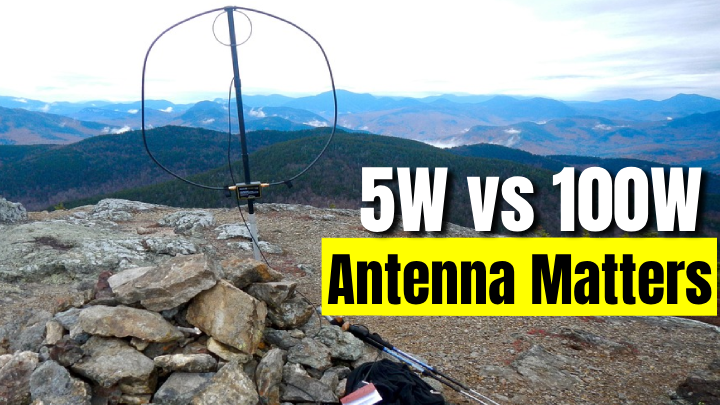
The math that changes everything
Let’s start with the decibels. Going from 100 watts to 5 watts is a 20:1 power change. In decibels, that is 10 × log10(100 / 5) which comes out to 13 dB. On the S-meter, that is a little more than two S-units if your meter actually follows the common 6 dB per S-unit convention. If your 100 watt signal is S7 at the other station, your 5 watt signal lands around S4.
How 100W vs 5W and antenna efficiency change your real signal
| Metric |
Value |
Why It Matters |
| Power drop: 100W to 5W |
13 dB (just over 2 S-units) |
This is baked in at QRP. You cannot get those dB back without changing antennas. |
| Loss from a poor antenna |
6 - 10 dB typical |
At 100W you can eat this loss. At 5W it often makes the difference between copyable and gone. |
Now layer antenna efficiency on top. Imagine a 50 percent efficient antenna. At 100 watts, that is 50 watts of effective radiated power, which is still a strong, workable signal on HF. At 5 watts, the same 50 percent efficiency gives you 2.5 watts ERP. That is not a lot of RF to waste in traps, undersized loading coils, lossy feedline, or a bad ground system.
QRP is all about your loss budget. At 100 watts, you have some room to be lazy. You can tolerate mediocre coax, a vertical with marginal radials, and a tuner trying to force a non-resonant length of wire to behave. At 5 watts, every decibel you throw away is a real chunk of your total output. Once you start stacking feedline loss, mismatch loss, and ground loss, your 5 watt rig can easily be pushing less than 1 watt into the ionosphere.
Turning the math into station choices
So what do you actually change when you decide to run QRP on HF? The rule of thumb is simple: you can’t afford casual inefficiency anymore. The same antenna that "works fine" at 100 watts might be a QRP killer at 5 watts. The good news is that most of the improvements that help QRP also make your 100 watt station better.
- Step 1: Pick the most efficient radiator you can fit: a full-size dipole or end-fed wire at a reasonable height beats a compromised, heavily loaded antenna almost every time.
- Step 2: Cut avoidable losses: shorter and better coax, fewer lossy connectors, and a matching system that is not chewing up power as heat.
- Step 3: Make it resonant where you actually operate so your tuner is cleaning up small mismatches instead of saving a wildly non-resonant antenna.
Ground loss becomes critical at QRP
At 100 watts, you can often ignore a sloppy ground system and still work plenty of stations. At 5 watts, ground loss is brutal. Every ohm of resistance in the ground system of a vertical antenna turns into real power loss. That energy does not turn into low-angle RF. It just warms the dirt under your radial field.
- Verticals without radials are especially painful at QRP. They tend to be very high angle or just plain lossy, which is why "no radial" marketing copy looks great until you try to run 5 watts through it.
- High-angle radiation that is fine for 100 watt NVIS work on 80 or 40 meters can kill you on 20 or 17 meters when you are trying to work DX on QRP.
- Even on bands where high-angle radiation is useful, you still cannot afford to burn half your power in a ground system that is basically a space heater.
Think of ground loss as yet another series resistor in your low power signal path. A few dB of loss in the ground system, a few more in a tight loading coil, a couple more in cheap coax, and your nice 5 watt QRP rig is effectively whispering into the ionosphere. If you love verticals, QRP pushes you toward doing them right: plenty of radials, reasonable loading, and honest expectations about efficiency.
Real-world antenna efficiency: the QRP killer
Every compromise in your antenna system is a tax on your signal. Loading coils, traps, tiny portable verticals, oddball feed arrangements, and very low heights above ground all take their share. When you run 100 watts, you can absorb a lot of this pain and still get spotted on the cluster. At 5 watts, a "50 percent efficient" setup changes from "good enough" into "barely gets heard."
The simple math is ugly: a 50 percent efficient antenna at 100 watts gives you 50 watts ERP. That is still respectable on HF. The same 50 percent efficiency at 5 watts gives you 2.5 watts ERP. Add a few more dB of feedline loss and mismatch, and you are effectively radiating on the order of 1 watt. Once you get down there, band conditions and noise floor swings easily swamp your signal.
What actually works at QRP power
The encouraging part is that you do not need exotic antennas to make QRP work. You just need to lean toward efficient, mostly resonant designs. The same simple antennas that new hams start with are often the best choice when you are trying to squeeze real performance out of 5 watts.
A full-size resonant dipole still wins a lot of comparisons. It is hard to beat a half-wave of wire up in the clear with low feedline loss. For park or field work, that might be an inverted V hung from a fiberglass mast. At home, it might be a traditional center-fed wire over the yard. However you hang it, a plain dipole is usually more efficient at QRP than a short, heavily loaded vertical stuck on a tripod.
QRP-friendly antennas vs common compromises
| Antenna type |
QRP performance |
Why It Matters |
| Full-size dipole |
Excellent efficiency, predictable pattern |
Minimal loss and no traps or big loading coils to eat your 5 watts. |
| EFHW antenna |
Very good if transformer is decent |
A quality EFHW with a proper transformer and decent height is a strong QRP performer. |
| Short loaded vertical, few or no radials |
Poor to fair at low power |
Ground loss and coil loss can burn most of your low power output before it ever radiates. |
End-fed half-wave (EFHW) antennas are also very QRP-friendly when built well. They let you cover multiple bands with a resonant radiator and a single matching transformer. If the transformer is efficient and you keep feedline loss under control, an EFHW can be a great low power antenna for portable work.
An off-center-fed (OCF) dipole is another solid option. A good OCF design gives you multiple resonant bands without a ton of fiddling and still keeps efficiency high. That makes OCF antennas attractive for low power operators who want band agility without paying the full penalty of a random wire and a struggling tuner.
Resonant vs non-resonant at 5 watts
At 100 watts, running a random length of wire into a tuner feels fine. The tuner works hard, the SWR looks reasonable, and contacts roll in. Behind the scenes, your tuner and feedline might be eating 3, 6, or 9 dB of power to make that happen. You can recover from that at 100 watts. At 5 watts, that same approach can easily turn into "nobody hears me."
A resonant antenna keeps the heavy lifting out at the wire instead of in the tuner. That does not mean your antenna has to be perfect, it just needs to be reasonably close on the bands you care about. A small mismatch that the tuner cleans up is not a big deal. A huge mismatch that sends high SWR back down a long run of coax is very expensive when your starting point is QRP output.
Practical QRP antenna tips that actually help
If you are serious about making QRP feel less frustrating and more fun, focus your effort on the bits of the system that actually move the needle. Power is mostly fixed. Antenna and losses are where you can win. Here are some easy wins that apply to pretty much every low power HF station.
- Shorten and upgrade your coax. Swapping a long run of lossy cable for a shorter run of better coax can be a noticeable dB gain at QRP.
- Favor full-size radiators. If you have a choice between a short loaded antenna and a full-size wire, the full-size option almost always gives your 5 watts a better chance.
- Put wire in the air, not in the tuner. Spend time trimming antennas for resonance on your most used bands instead of trying to force a random wire to handle everything.
If you want more ideas on wire layouts and feed options, the Antennas Section has several articles that pair nicely with this one. Newer operators might also want to skim the Getting Started, and anyone experimenting across bands can dive into the broader radio articles for more antenna-specific builds.
Frequently Asked Questions
Why does my antenna matter more at 5 watts than at 100 watts?
Going from 100 watts to 5 watts already costs you 13 dB. At 100 watts you can absorb sloppy losses in coax, ground systems, and matching networks and still be heard. At 5 watts those same losses can swamp your entire signal, so antenna efficiency directly determines whether you make a contact or not.
What is the most efficient HF antenna for QRP?
A full-size resonant dipole at a reasonable height is hard to beat. End-fed half-wave (EFHW) antennas with a quality matching transformer and off-center-fed (OCF) dipoles are also very QRP-friendly because they keep the radiator full size and avoid heavy loading.
Are short loaded verticals usable for QRP?
They can work, but only if you commit to a real radial system and accept the loss in the loading coil. Without enough radials a short vertical can burn most of your QRP output as heat in the ground. If you must use a short vertical, lay down as many radials as you can and keep feedline runs short.
How much does feedline loss really matter at QRP?
A lot. Two or three dB of coax loss at 100 watts is annoying. The same loss at 5 watts can be the difference between being heard and being noise. Use shorter, lower-loss feedline like LMR-400 or hardline for permanent installs, and keep portable runs short with quality cable.
Is a tuner enough to make any antenna work for QRP?
No. A tuner makes the radio see 50 ohms but does not undo loss in the antenna or feedline. A tuner forcing a wildly non-resonant wire to load up at 5 watts can leave very little RF actually radiating. Build a resonant or near-resonant antenna first, then use the tuner to clean up the small remaining mismatch.
Should I just go back to running 100 watts?
If you want effortless contacts, sure. But QRP is rewarding precisely because it forces you to optimize the system. Once you fix the antenna, feedline, and ground, the same improvements help your 100 watt station too. Many operators find that running QRP teaches them more about antennas in a year than years of running 100 watts ever did.
So why does your antenna matter more at 5 watts?
Once you commit to QRP, your entire station becomes a game of managing losses. The 13 dB hit from 100 watts down to 5 watts is locked in. You cannot twist a knob to get those decibels back. What you can do is stop throwing away more of them with a poor antenna and sloppy ground system.
- At 5 watts, ground loss, loading coils, traps, and bad feedline are often the real QRP killers, not the radio.
- Efficient antennas like full-size dipoles, well-built EFHWs, and sensible OCF dipoles give your low power a fighting chance.
- Resonant or close-to-resonant antennas and clean matching keep your precious QRP output from turning into heat.
If you want your 5 watt station to sound like it punches above its weight, start by fixing "the wire in the air" before you think about buying another rig.