The Radioddity HF-010 is the successor to the HF-009, one of the more popular portable verticals in the ham radio world. At $239, it covers 80 through 6 meters, packs into a carrying case, and ships with nearly everything you need to get on the air. On paper, it looks like a solid upgrade. But the only way to know how it actually performs is to run the data. That is what this review does.
What You Get for $239
The HF-010 ships in a carrying case with everything bundled together. There are two ways to think about the $239 price: what you are getting in the box, and whether the performance justifies the cost compared to alternatives. Start with the box.
Mounting options come in three flavors. The ground stake is back from the HF-009 for soft ground deployments. The included tripod is new and useful for parking lots, rocky summits, or anywhere you cannot drive a stake. It does not adjust for height, so you will need a reasonably flat surface, but it works well for what it is. A third option, mounting on a mag mount, requires an optional adapter that Radioddity sells separately, but it screws right on once you have it.
The antenna itself assembles from the base up. You choose your coil based on the band: the single coil for 80 meters, or the adjustable coil for 40 through 6. One of the most practical upgrades on the HF-010 is that the adjustable coil now has numbers on the scale. That sounds minor until you have wasted ten minutes trying to re-find last week's 20 meter setting. The stainless steel whip is another upgrade over the HF-009, and the included tape measure means you can trim the whip to length without a separate trip to the hardware store.
The HF-010 ships with a ground stake, a tripod, a stainless steel adjustable whip, a numbered adjustable coil, an 80 meter coil, a coax reel, radial reels with band-setting markers, a BNC adapter, a tape measure, and a stability bag for the tripod.
The radials are now on reels, which is a real quality-of-life improvement over loose wire management. Unroll them and you will notice white dots spaced roughly every meter, these correspond to the manual's band-by-band recommendations for how far to unwind. The coax also comes on its own reel now, though there is one gotcha: it ships zip-tied to the reel at full extension. Cut that zip tie before you try to roll it back up. The kit also includes a bag you can fill with water or sand to weight down the tripod in wind.
| Item |
Notes |
| Ground stake |
For soft ground deployment |
| Tripod |
Fixed height; great for parking lots and summits |
| 80m coil |
Single coil; swap in place of the adjustable coil |
| Adjustable coil (numbered) |
Covers 40m–6m; numbered scale is a new upgrade |
| Stainless steel whip |
Upgraded material over HF-009 |
| Tape measure |
For adjusting whip length per band |
| Coax on a reel |
Upgraded from loose coax; cut the zip tie before first use |
| Radials on reels |
White dot markers indicate per-band unwind length |
| BNC adapter |
Included |
| Stability bag |
Fill with water or sand for tripod ballast |
How the Antenna Was Tested
If you have not seen the antenna testing methodology video, the short version is this: WSPR beacons at 4 watts through a QDX, and an automated antenna switch driven by an ESP32 and Home Assistant alternates between the HF-010 and the reference antenna after each transmit cycle. A small console application logs which antenna was active at each WSPR timestamp. After each session, the reception data gets pulled from WSPR Rocks as JSON and compared against the switch log.
The reference antenna for all comparisons is an end-fed halfwave (EFHW). The goal is an A/B test under the same band conditions, not a laboratory. No test like this is perfect, but it is orders of magnitude more useful than a handful of contacts and a thumbs-up. For a full walkthrough of the methodology, see the testing methodology article.
20 Meter Results
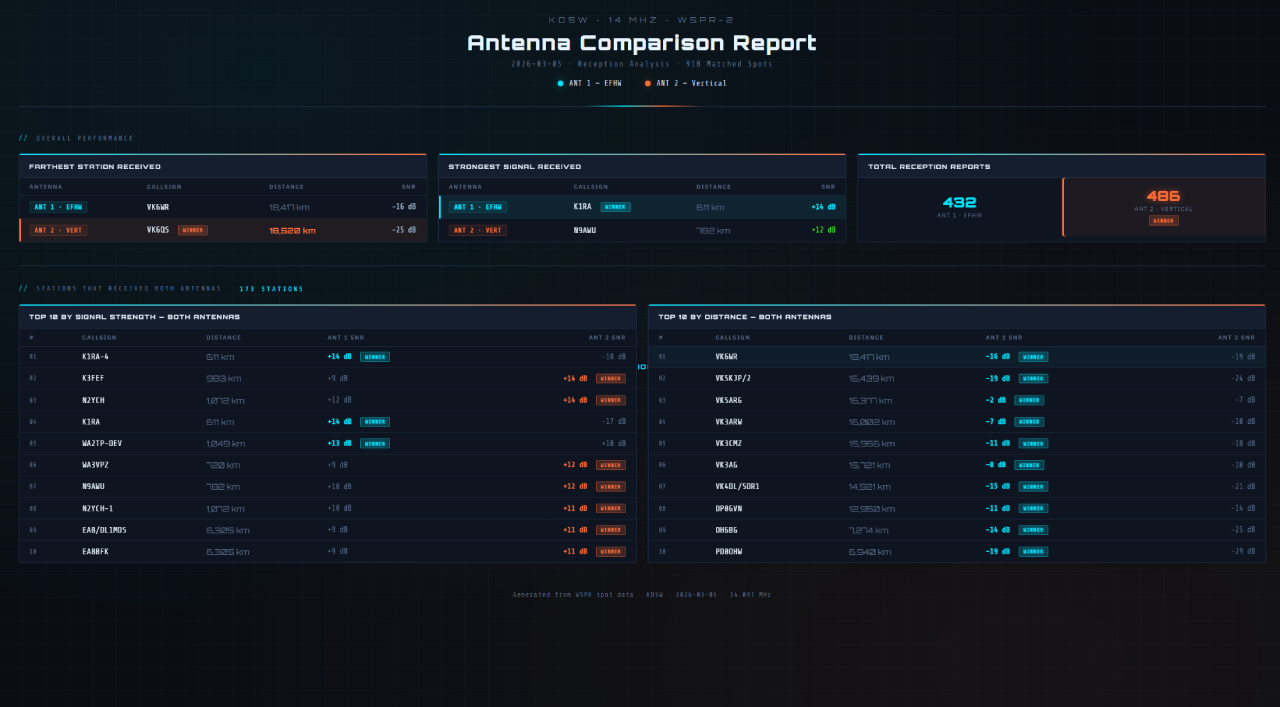
On 20 meters, both antennas reached Australia. The HF-010 actually edged out the EFHW on maximum distance by about 100 kilometers. The strongest individual signal report of the session went to the EFHW, so neither antenna ran away with it at the top end.
The more telling comparison is the head-to-head among the 173 stations that received both antennas. Among those, the HF-010 won on signal strength 7 to 3 over the EFHW. That is a meaningful result for a compact portable vertical. On distance among those same shared stations, the EFHW swept cleanly.
| Metric |
HF-010 |
EFHW |
| Reached Australia |
Yes |
Yes |
| Max distance edge |
~100 km ahead |
— |
| Strongest single signal report |
— |
Yes |
| Signal strength wins (173 shared stations) |
7 out of 10 |
3 out of 10 |
| Distance wins (173 shared stations) |
— |
Clean sweep |
40 Meter Results
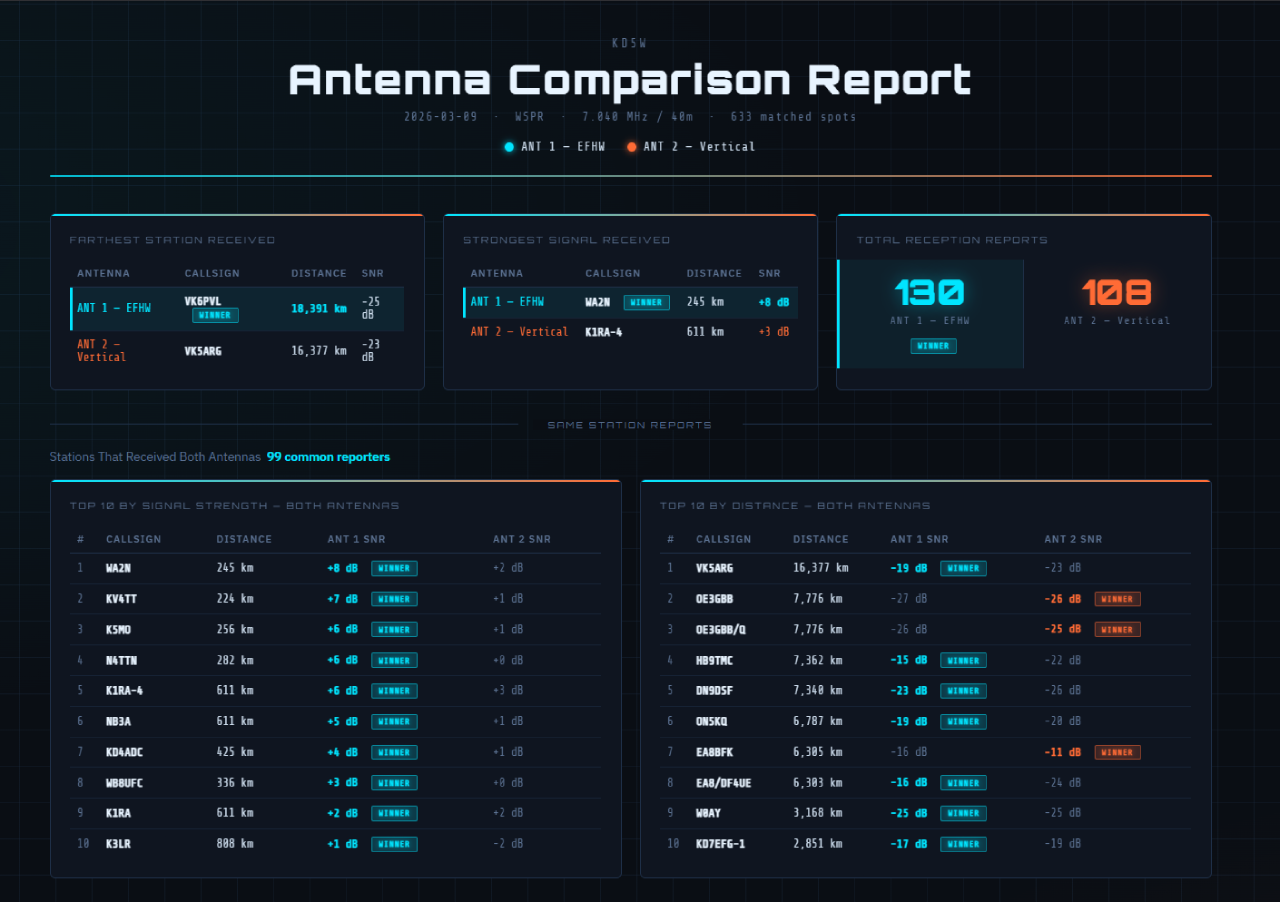
The 40 meter picture is less favorable for the HF-010. Both antennas made it to Australia, but the EFHW beat the HF-010 by around 2,000 kilometers in maximum distance. The EFHW also had the strongest individual signal report of the session. Among the 99 stations that received both antennas, the EFHW dominated on signal strength.
The DX miss comparison tells the clearest story. Among stations beyond typical ranges, the EFHW reached 19 DX contacts that the HF-010 never heard from. The HF-010 reached only 2 that the EFHW did not. On 40 meters, the EFHW is the stronger performer and the data does not leave much room for argument.
| Metric |
HF-010 |
EFHW |
| Reached Australia |
Yes |
Yes |
| Max distance edge |
— |
~2,000 km ahead |
| Strongest single signal report |
— |
Yes |
| Signal strength (99 shared stations) |
— |
Dominated |
| Top 10 distance stations won |
3 out of 10 |
7 out of 10 |
| DX stations reached that other antenna missed |
2 |
19 |
Frequently Asked Questions
Is the Radioddity HF-010 worth $40 more than the HF-009?
For most operators, yes. The HF-010 adds a numbered adjustable coil, a stainless steel whip, radials on reels, coax on a reel, and 80 meter capability. That is a meaningful set of upgrades for $40. Whether the performance data justifies it depends on how you use the antenna, but the build quality improvements alone are noticeable.
How does the Radioddity HF-010 perform on 20 meters?
On 20 meters, the HF-010 performed competitively against an EFHW reference. Among stations that received both antennas, the HF-010 won on signal strength 7 to 3. The EFHW had the edge on maximum distance, but it was close.
How does the Radioddity HF-010 perform on 40 meters?
On 40 meters the EFHW leads more clearly. The EFHW beat the HF-010 by around 2,000 kilometers in maximum distance, and the EFHW reached 19 DX stations that the HF-010 missed entirely. The HF-010 only reached 2 stations the EFHW did not.
What mounting options does the HF-010 include?
The HF-010 ships with a ground stake for soft ground and a tripod for flat hard surfaces like parking lots or rocky summits. An optional mag mount adapter is also available from Radioddity for vehicle or other surface mounting.
Does the HF-010 work for POTA and SOTA activations?
Yes, this is exactly what it is designed for. The full kit packs into a carrying case, the radials are on reels, the coax is on a reel, and you have ground stake, tripod, and (optional) mag mount options. Setup time in the field is around five to ten minutes once you know the antenna. The 80 to 6 meter coverage covers every band that matters for POTA and SOTA.
Do I need to retune the HF-010 every band change?
Yes, but the new numbered scale on the adjustable coil makes it fast. You set the coil tap to the recommended position for your band, set the radial reels to the marked length for that band, and trim the whip if needed. Once you have logged your settings for each band, future band changes take less than a minute.
Bottom Line
The Radioddity HF-010 is not going to outrun a well-deployed EFHW on 40 meters, the data makes that clear. On 20 meters the story is more interesting, with the HF-010 winning on signal strength among shared stations while losing on pure distance. What the numbers cannot fully capture is the practical value of everything that comes in that case: three mounting options, a numbered coil, a stainless steel whip, radials on reels, coax on a reel, and 80 meter capability, all packed and ready to deploy.
That is what you are paying for with the $40 premium over the HF-009. Not a laboratory-grade performer, but a genuinely capable, complete field kit that gets you on the air fast. For POTA activators, portable operators, or anyone who needs to work multiple bands without lugging separate wire antennas, the HF-010 makes a strong case for itself.
Useful Links