If you are a new ham staring at a spool of cable on a website and wondering what the difference is between RG-58, RG-8X and LMR-400, you are not alone. Coax feels like the most boring part of the station, but it quietly decides how much of your signal actually makes it to the antenna and how much ends up as heat in the line.
Think of coax as the plumbing between your radio and antenna. Thin hose is cheap and easy to run, but it does not move as much water. Thick hose carries more, but it is heavy and harder to bend around tight corners. Coax is the same story in RF form: diameter, construction, and frequency all affect how much signal you lose along the way.
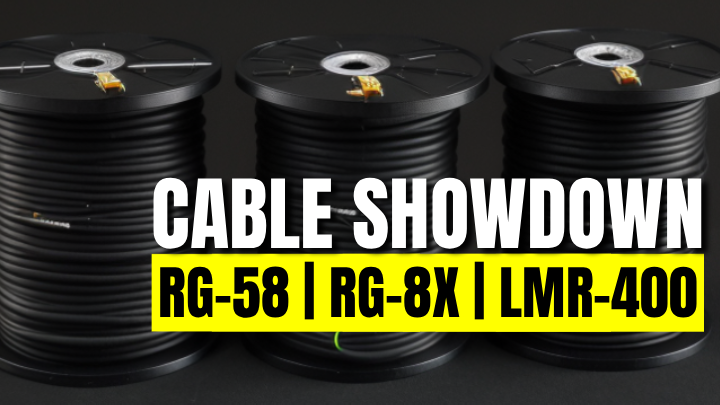
This guide focuses on three common 50 ohm cables you will see in ham radio shops: RG-58, RG-8X and LMR-400. We will look at typical loss numbers, show simple comparison charts, and then give practical recommendations for HF, VHF/UHF, short vs long runs, and indoor vs outdoor use.
Why your coax choice matters more than the radio sometimes
It is easy to get excited about a shiny new HF rig or a feature-packed VHF/UHF mobile. The problem is that a mediocre feed line can quietly throw away half (or more) of that radio’s performance. On HF with a short run, you may never notice. On 2 meters or 70 cm with a long run of skinny coax, the difference between cheap cable and decent cable can be several S-units at the other end.
Quick comparison: RG-58 vs RG-8X vs LMR-400 at 146 MHz (per 100 ft)
| Coax type |
Approx. loss @ 146 MHz / 100 ft |
Why it matters |
| RG-58 |
~3.5 dB |
You lose about half your power in 100 ft. Fine for short runs, rough for long VHF feed lines. |
| RG-8X |
~2.7 dB |
A bit thicker and heavier, but noticeably less loss than RG-58. Good compromise for many base stations. |
| LMR-400 |
~1.3 dB |
Most of your power gets to the antenna. Great for longer runs or weak-signal VHF/UHF work. |
A simple way to pick the right coax for your first station
Instead of memorizing every spec sheet, use three basic questions: How long is the run, what bands are you using, and how hard will the cable be to route? Answer those and you can land on the right family of coax most of the time.
- Step 1: Decide your longest feed line length from radio to antenna and whether it is mostly HF (below 30 MHz) or VHF/UHF.
- Step 2: If the run is short (under about 50 ft) or mostly HF, you can usually use RG-58 or RG-8X and put more budget toward antennas.
- Step 3: If the run is long and you care about VHF/UHF performance, step up to RG-8X or LMR-400 and keep the skinny stuff only for short jumpers.
RG-58 vs RG-8X vs LMR-400: strengths, weaknesses and where they fit
Here is a quick overview of how these three cables compare before we dig into detailed loss charts. Numbers vary a bit by brand, but the general pattern is very consistent across the common options you will find at ham radio stores or places like DX Engineering, Radioddity or HRO.
- RG-58: About 0.2 inch diameter, very flexible, inexpensive, higher loss at VHF/UHF. Great for short jumpers, mobile installs and short HF runs.
- RG-8X: Slightly larger (around 0.24 inch), still flexible, moderate loss. Sweet spot for many new ham base stations where runs are 50–100 ft.
- LMR-400: Larger (about 0.4 inch), stiffer, lower loss. Best for longer runs and higher frequencies, but harder to work around tight corners and through walls.
Loss charts for RG-58, RG-8X and LMR-400 at common ham bands
Coax loss is usually given as dB per 100 feet at a specific frequency. A 3 dB loss means half your power is gone. The higher the frequency, the more loss you get for the same length of cable. That is why feed line that is fine for HF can be painful on 70 cm.
The table below uses typical published numbers for decent quality cable. Different manufacturers will vary a little, but this gets you in the right ballpark when you are planning a station.
| Band / frequency |
RG-58 (100 ft) |
RG-8X (100 ft) |
LMR-400 (100 ft) |
| 40 m HF (~7 MHz) |
~0.5 dB |
~0.4 dB |
~0.2 dB |
| 10 m HF (~28 MHz) |
~1.0 dB |
~0.8 dB |
~0.4 dB |
| 2 m VHF (~146 MHz) |
~3.5 dB |
~2.7 dB |
~1.3 dB |
| 70 cm UHF (~446 MHz) |
~6.5 dB |
~4.9 dB |
~2.3 dB |
To scale this for your actual station, just multiply by your length divided by 100. For example, a 60 ft run of RG-58 on 2 meters is roughly 0.6 of the numbers above: 0.6 × 3.5 dB is about 2.1 dB of loss. That is noticeable, but probably fine for a casual repeater station.
Real-world use cases for each coax type
Charts are nice, but it helps to see how this plays out in actual ham radio setups. Here are some common scenarios and which coax type usually makes sense.
RG-58: the flexible workhorse for short runs
RG-58 has been around a long time. It is cheap, bends easily, and uses smaller connectors that are easier to fit in tight spaces. The tradeoff is higher loss, especially above HF. Use RG-58 when:
- Your run is short, roughly 25–50 ft or less.
- You are mostly on HF where coax loss is naturally lower.
- You are wiring up jumpers between radios, tuners, and meters in the shack.
- You need something very flexible for mobile installs in vehicles.
For a first HF-only station with the antenna in the backyard and a relatively short feed line, RG-58 can be perfectly acceptable. You can always upgrade the outside run later if you start chasing weak signals.
RG-8X: the "good enough" default for many new base stations
RG-8X (sometimes called "mini RG-8") is only a bit larger than RG-58, but that small change buys you noticeably lower loss. It still routes through walls and conduit without a fight, and most new hams find it easier to work with than big, stiff cables.
RG-8X is a solid choice when:
- Your main feed line is in the 50–100 ft range.
- You are running a mix of HF and VHF (2 m) from a base station.
- You want better performance than RG-58 but do not want to wrestle with LMR-400.
- You are feeding common 100 watt rigs and typical wire or vertical antennas.
If you are not sure what to get and you are building a basic station described in many ham radio getting started guides, RG-8X is often the safest middle ground.
LMR-400: low-loss cable for long runs and higher frequencies
LMR-400 (and similar cables like "RG-8 size" foam dielectric coax) is where loss really drops. The flip side is that the cable is thicker, heavier and stiffer. That is fine for a straight run up the side of a house, but less fun when you are trying to turn tight corners in an apartment.
LMR-400 is worth the cost and hassle when:
- You have a long feed line, say 75–150 ft or more.
- You care about performance on 2 meters, 70 cm, or higher.
- You are doing weak-signal work, satellites, SSB on VHF/UHF, or digital modes where every dB matters.
- You want to build once and not wonder if the coax is the weak link.
For serious VHF/UHF or for a permanent base station where the feed line will likely stay in place for years, stepping up to LMR-400 is usually cheaper than trying to make up for coax losses later with amplifiers and more complex antennas.
HF vs VHF/UHF: why the same coax behaves differently
On HF, coax loss is relatively small. Even RG-58 at 7 MHz only loses around half a dB per 100 ft. That is barely noticeable in practice. So on 80, 40 or 20 meters you can often get away with whatever reasonable 50 ohm cable you have on hand, especially if the run is short.
On VHF and UHF, loss climbs fast. At 446 MHz, that same 100 ft run of RG-58 is losing around 6.5 dB, which is well over three quarters of your power. If you are mostly using a repeater in town with a big antenna on a tower, you might still be happy. If you are trying to hit a marginal repeater or work simplex, you will definitely feel the difference.
Practical tips for routing and installing coax
Even the best coax can perform poorly if it is installed badly. A few simple habits will help whatever cable you choose last longer and keep losses where you expect them to be.
- Keep bends gentle. A good rule is a bend radius no tighter than about 10 times the cable diameter, especially for LMR-400 size cable.
- Protect outdoor connectors. Use proper weatherproofing tape or self-amalgamating rubber over a layer of electrical tape, not just a bare PL-259 hanging in the rain.
- Plan for strain relief. Do not let the full weight of a vertical or a long run hang on one connector. Anchor the coax to the mast or wall with clamps or UV-rated zip ties.
Frequently Asked Questions
Is RG-58 good enough for HF ham radio?
Yes, as long as the run is not very long. On 40 and 20 meters, a 50 to 75 foot length of RG-58 only loses a dB or so, which you are unlikely to notice in normal operation. If you later add VHF or UHF gear to the same feedline or push out to much longer runs, then it is worth looking at RG-8X or LMR-400.
When should I really spend the extra money on LMR-400?
The simplest trigger is a long run at VHF or UHF. If you are running more than about 75 feet of cable and you care about 2 m or 70 cm performance, LMR-400 or similar low-loss coax is usually worth it. It is especially helpful for satellite work, SSB on 2 m, or any situation where signals are weak and every dB matters.
Can I mix different coax types in the same station?
You can. Many stations use LMR-400 for the main outside run and RG-8X or RG-58 jumpers inside the shack. As long as everything is 50 ohms and connectors are installed correctly, the only downside is a little added loss at each connector and in the higher-loss sections. Keep the long, high-frequency runs on the better coax and use the more flexible stuff where it really helps with routing.
What about "RG-8" that I see listed separately?
RG-8 traditionally refers to a full-size coax around the same diameter as LMR-400, but with different construction and usually a little more loss. Some modern cables branded as RG-8 are actually foam-dielectric, low-loss designs that perform closer to LMR-400. Always check the actual loss specs on the data sheet, not just the name on the jacket.
Should I ever use 75 ohm cable like RG-6 with my 50 ohm gear?
For most new hams, it is easier to stick with proper 50 ohm cable. There are ways to make 75 ohm cable work in specific situations, but you are trading cheap cable for more complexity and potential mismatch. Once you are comfortable with station building, you can experiment. For a first station, a solid 50 ohm cable keeps life simple.
How do I scale a published 100-foot loss number to my actual cable run?
Multiply the per-100-foot loss by your actual length divided by 100. For example, a 60-foot run of RG-58 on 2 meters with a 3.5 dB per 100 ft figure works out to 0.6 times 3.5 dB, or about 2.1 dB. That math is enough for station planning without breaking out a calculator for every band.
So which coax should you buy first?
For many new hams, the right answer is not "buy the most expensive cable you can find," it is "match the cable to your actual station." Short HF run in a small house? RG-58 is probably fine. A mixed HF and 2 m base station with a 75 ft run to the roof? RG-8X hits a good balance. Long VHF/UHF feed line where every dB matters? Go straight to LMR-400 or similar low-loss cable and be done with it.
- Use RG-58 for short runs, jumpers and mobile installs where flexibility matters more than ultra-low loss.
- Pick RG-8X as a solid default for 50–100 ft base station runs that cover both HF and VHF.
- Choose LMR-400 when feed lines are long, frequencies are high, or you are chasing weak signals and want minimal loss.
If you are still unsure, sketch your station layout, estimate your longest cable length, and then compare a couple of options from your favorite supplier. Then focus on the fun stuff: radios, antennas, and getting on the air. When you are ready for the next step, check out the Antenna Articles and our Gear Reviews to round out your station plan.