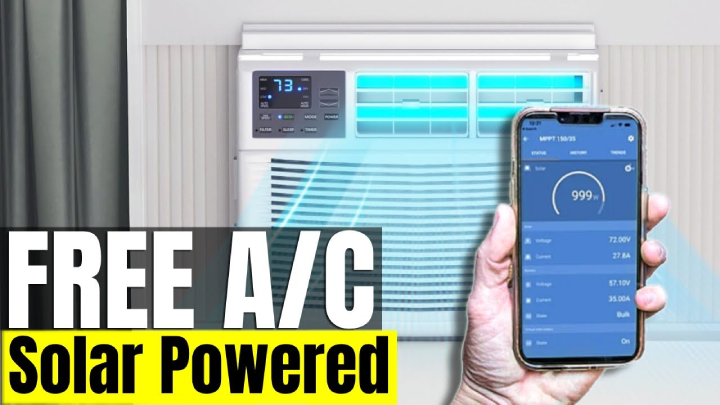
Most of us think of solar as a way to keep lights, radios, and a few outlets running when the grid drops. The question that keeps coming up is tougher: can a modest backup solar system actually run an air conditioner, and keep a chunk of your house livable when it is pushing 100°F outside? I decided to find out by hanging a GE Profile inverter window AC on my backup solar setup and running it through an entire summer.
I originally built this solar system as a backup power source, then started running my office off it. The problem was simple: office gear just doesn’t use much power, so a good chunk of the available energy was going to waste on sunny days. That got me thinking about the biggest hog in the house, the central air system, and whether a smaller, more efficient AC unit could be pushed by the inverter instead.
Central air is far outside the comfort zone of most small inverters, so I picked up a 110V GE Profile inverter window air conditioner. On paper it looked like a good match for the inverter’s continuous rating, and the inverter has a beefy toroidal transformer, so I was hopeful it could swallow the startup surge. The goal wasn’t to cool the whole house, just to carve out a comfortable zone that my family could retreat to if the grid went down.
The Solar Setup And The Window AC
The solar side of this project is a typical small backup system: panels feeding a charge controller, a battery bank, and a 1,200W pure sine inverter. The inverter is rated for 1,200 watts continuous, with a toroidal transformer that can handle short surge events without instantly tripping. It had no trouble with radios, computers, and the usual shack loads, so the AC would be the real test.
How Much Power Does A Solar Window AC Really Use?
| Metric |
Value |
Why It Matters |
| Rated cooling power (packaging) |
About 1,200–1,220 watts |
This is what the GE Profile inverter window unit is expected to draw at maximum output. |
| Measured peak draw (Kill A Watt) |
Up to ~1,434 watts on high |
These real-world spikes occasionally pushed the 1,200W inverter into shutdown, especially when the unit cycled hard on high. |
The GE Profile is an inverter-style window AC, which means the compressor speed is variable instead of a simple on/off bang-bang cycle. In theory that should reduce power draw and make the unit a nicer partner for a small inverter. It is also supposed to be quieter, which my wife would argue about. She found it pretty noisy on high, especially if she was watching TV in the same room. Personally, I kind of liked the fan noise and had no problem falling asleep on the couch with it running.
To get real numbers, I plugged the AC into a Kill A Watt meter and let it run for several days. Most of the time the draw stayed well under the inverter’s continuous rating. The surprise was those short moments when the unit cycled hard on high: the meter showed peaks around 1,434W, and that’s where the inverter would occasionally throw up its hands and shut down.
What The Test Showed About Cooling On Solar
In spite of those brief overloads, the system did something important: it kept about 1,000 square feet of the house at 72°F while it was roughly 100°F outside. That’s not a whole-house solution, but it is a big, livable chunk of space. Think living room plus connecting areas, where you can put kids, older family members, pets, and whoever is struggling with the heat.
Basic Steps To Run A Window AC On Solar
You don’t need an identical setup to copy this idea, but there are a few practical steps I’d follow if you want to run a similar window unit on your own backup solar system.
- Step 1: Match the AC to the inverter. Take the AC’s rated wattage (in this case around 1,200W for the GE Profile inverter unit) and make sure your inverter’s continuous rating meets or beats it, with some headroom for startup spikes.
- Step 2: Measure real-world draw with a meter. Plug the AC into a Kill A Watt or similar meter and run it on high for several hours so you know the true peak and typical power usage, not just the number on the box.
- Step 3: Dial in the thermostat and fan speed. If high causes inverter shutdowns, set the unit to medium and use the thermostat to maintain a reasonable indoor temp while protecting the inverter.
Solar Window AC vs Central Air
Most homes are wired and sized for central air, so dropping down to a single window unit on solar feels like a step backward. In practice, it is just a different tool. The goal isn’t to make the entire house feel like nothing happened. The goal is to carve out a survivable zone when the grid is gone or the power company is struggling. Here’s how the two approaches stacked up in this test.
- The central air could easily cool the whole house, but was far too power-hungry for a 1,200W inverter and small battery bank.
- The window unit, fed by solar, reliably cooled about 1,000 square feet, giving us a comfortable core while leaving the rest of the house warmer.
- By setting the window AC to 72°F and the central system to 74°F, the central air only kicked in if the solar side fell behind or shut down.
Real-World Cooling Performance Over A Summer
I ran the GE Profile inverter window unit on solar through a full summer. Most days were uneventful in a good way: the AC held the living area at around 72°F while the thermometer outside hovered near 100°F. The inverter carried the load without complaint as long as the unit stayed off the highest fan setting.
There were only a few times where the power spikes around 1,434W caused the inverter to shut down. The fix was simple: I adjusted the AC so it ran on medium instead of high. That kept the draw lower and steadier, and the house still stayed comfortable. The other limit was the weather. During a week or two of rain and heavy clouds, there just wasn’t enough solar to keep the system happy every single day. On those days the window unit stayed off, and the central air (set slightly warmer) or plain old fans took over.
Practical Tips And Common Questions
If you’re thinking about trying something similar, it helps to be realistic about what a small solar system can and cannot do. Here are some practical tips pulled straight from this project that should save you a little trial and error.
- Size for the surge, not just the sticker. A “1,200W” AC that briefly spikes to 1,400W will stress a 1,200W inverter. If your inverter is smaller, either pick a smaller AC or expect more frequent shutdowns.
- Pick your safe zone in advance. Decide which 800–1,000 square feet you want to keep cool, and plan furniture, doors, and airflow around that. Close off extra rooms when you’re on solar to help the AC keep up.
- Plan for bad weather weeks. Assume there will be days where clouds win and solar loses. Keep your central air thermostat a degree or two warmer as a backup, and consider a small generator or larger battery bank if this is your primary emergency cooling plan.
Frequently Asked Questions
Can a small solar system really run a window air conditioner?
Yes, if your inverter and battery bank can handle roughly 1,200 to 1,500 watts of continuous load plus startup surge. In this project a 1,200W pure sine inverter successfully ran a GE Profile inverter-type window AC, with measured peaks around 1,434W when the unit cycled on high.
How much of the house can you realistically cool on solar?
With this setup, about 1,000 square feet stayed at roughly 72°F while it was close to 100°F outside. Cooling the whole house would require more solar, more battery, and probably a second AC or a larger unit, so think of this as a "safe zone" rather than whole-home cooling.
What happens when it's cloudy for several days?
This system worked great on sunny days, but during a week or two of rain and cloud cover there simply wasn't enough solar input to run the window AC every day. When you plan solar-powered cooling, always assume there will be multi-day stretches where you fall back to grid power or central air.
Why an inverter-style window AC instead of a regular one?
Inverter-style window units use a variable-speed compressor that ramps up smoothly instead of slamming on and off. That dramatically reduces startup surge and lets a smaller inverter and battery bank stay inside their continuous rating most of the time. Traditional bang-bang compressors can spike well over twice their rated wattage at startup, which is rough on small inverters.
What size inverter and battery bank should I plan for?
For a single inverter-style window AC, plan on at least a 1,500–2,000W pure sine inverter so peaks stay comfortably below the rating, plus enough lithium battery to cover the run time you actually need. A few hours of cooling on battery alone is much easier to engineer than a full afternoon, so size to your worst likely outage rather than to perfect sunny conditions.
Is solar window AC a substitute for central air?
No. Treat it as a layered backup, not a replacement. A small solar setup with a window AC keeps one part of your house comfortable when central air is down or grid power is unreliable. For full-home cooling on solar you would need a much larger PV array, a bigger battery bank, and either a high-power inverter feeding central air or a couple of mini-splits.
Is A Solar-Powered Window AC Worth It?
Running a window air conditioner on a modest solar backup system turned out to be not only possible, but genuinely useful. It won’t replace central air for whole-house comfort, but it can absolutely keep a big chunk of your living space livable when it’s brutally hot outside and the grid is unreliable or gone.
- With a 1,200W pure sine inverter and an efficient inverter-style window AC, you can cool roughly 1,000 square feet down into the low 70s on sunny days.
- Power spikes and cloudy weeks are the two big limitations, so fan settings, thermostat tweaks, and realistic expectations are key.
- Treat this as part of a layered plan that might also include fans, central air at a higher setpoint, and other backup power gear.
If you’re building your own backup system, start by measuring your loads, then look at other project ideas and gear reviews on Broken Signal to dial in a setup that keeps your radios on, your family comfortable, and your house ready for the next outage.