TL;DR — What Take Off Angle Really Means
- What it is: The elevation angle where your antenna radiates the most power.
- Why it matters: Low angles reach faraway stations; high angles favor nearby coverage.
- What you control: Antenna height, antenna style, ground quality, and band choice.
- Bottom line: Take off angle determines whether your signal shoots shallow for DX or nearly straight up for regional NVIS.
If you've ever heard someone on the air brag about a "7 degree take off angle" or stared at an antenna model full of strange elevation lobes, you probably wondered why any of that matters. Here's the plain truth. Take off angle tells you where your RF is actually leaving the antenna, and once you get that, a lot of on-air mysteries suddenly make sense. It can be the difference between working the guys two states away or breaking a pileup halfway around the world.
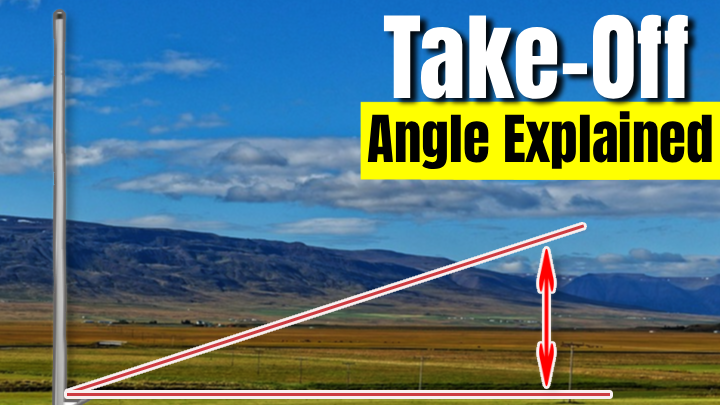
Think of take off angle as the launch direction of your RF. A 10 degree take off angle means your signal skims along close to the horizon, travels a long way, and then comes back down after its first hop hundreds or even thousands of miles out. A 70 degree angle sends energy almost straight up, hits the ionosphere quickly, and drops back down close to home. That’s exactly what you want for solid NVIS coverage.
Unlike SWR, there’s no meter you can plug in and read off a number. But you don’t need one. A few basic rules of thumb, some simple modeling, and paying attention to where your best contacts actually come from will tell you everything you need to know. Once this clicks, it becomes one of the most useful concepts you can apply to your station.
What Hams Really Mean When They Talk About Take Off Angle
When hams talk about take off angle, they’re talking about the strongest lobe in the antenna’s vertical radiation pattern. Picture slicing the pattern in half and looking at it from the side. The horizon is 0 degrees, straight up is 90 degrees, and somewhere in between is where most of your signal energy is focused. That direction is your primary take off angle for that band and setup.
Typical Take Off Angles for Common HF Goals
| Use Case |
Typical Take Off Angle |
Why It Matters |
| Local & regional (NVIS) |
60–90 degrees |
High-angle radiation reflects nearly overhead and fills in coverage within a few hundred miles. |
| DX across continents |
5–15 degrees |
Low-angle radiation travels long distances before its first hop, reaching faraway regions reliably. |
The big mistake is thinking take off angle is a fixed number. It isn’t. It changes with band, antenna height, ground conditions, and antenna type. A dipole that works great for DX on 20 meters can behave like a textbook NVIS antenna on 40 meters without you touching a thing.
Instead of chasing exact degrees, think in buckets. High angles for regional work. Low angles for DX. Everything in the middle for general operating. Real antennas throw off multiple lobes anyway, and propagation decides which one actually matters at any given moment.
How to Actually Understand Your Station’s Take Off Angle
You don’t need a degree in RF engineering to figure this out. A few checks and some honest on air observation will tell you far more than obsessing over a single number from a modeling program.
Start by looking up a NEC model or using a basic online calculator for your antenna at different heights. You’ll see right away how the elevation lobes move as you raise or lower it. Then compare that to your real world install. A horizontal antenna below about 0.3 wavelengths throws energy high. Once you get above about 0.5 wavelengths, the lower angles start to dominate.
After that, look at your logs. Who do you work easily? Who’s a struggle? If most of your strong contacts are close in, you’re living in the high angle world. If DX lights up on certain bands or times, those low angle lobes are doing their job. That real world feedback beats theory every time.
Programs like 4NEC2 and EZNEC make this visual and obvious, but even simple web tools show the same story. Raise a horizontal antenna and the main lobe drops. Verticals naturally favor low angles, especially with a solid radial system. That’s why a basic vertical in a small yard can embarrass a low dipole for DX, even at QRP levels.
If you’re still learning antennas, the Antennas section and Getting Started guides on Broken Signal fill in the background nicely. Once you connect antenna patterns to propagation, station design stops feeling like guesswork.
Vertical vs Horizontal Antennas and Take Off Angle
You’ve probably heard the line, “verticals are for DX and dipoles are for locals.” There’s some truth there, but it’s far from the whole story.
A quarter wave vertical with a decent radial field throws a strong low angle lobe, often under 20 degrees, which is why it works so well for DX. A horizontal dipole at half a wavelength or higher does the same thing, even though plenty of hams assume dipoles can’t compete. On the flip side, a very low horizontal antenna, like a 40 meter dipole at 10 or 15 feet, sends most of its energy high. That’s perfect for NVIS and terrible for long haul DX.
So yes, verticals are often the easiest way to get low angles on multiple bands. But a high dipole or beam on a tower can match or beat them. The best antenna is the one that fits your space, your bands, and what you actually want to work.
How Propagation and Band Choice Change Your Effective Take Off Angle
This is where a lot of hams get confused. Even if your antenna has a beautiful 10 degree lobe, that doesn’t mean it’ll always work.
The ionosphere decides which angles come back down. A 10 degree shot on 20 meters around sunset might put Europe in your log with ease. That same angle on 10 meters at the wrong time can sail right through and never return. Tools like VOACAP and propagation apps help predict which angles are likely to work on a given band and path.
What this means in practice is that a simple multiband dipole with several lobes can be surprisingly flexible. As conditions change, different lobes become useful. You end up with options you didn’t even know you had.
Practical Tips to Choose an Effective Take Off Angle
You don’t need formulas. You need results.
For NVIS on 40 and 80 meters, keep your antenna low, roughly 0.15 to 0.25 wavelengths. That pushes energy high and fills in regional coverage. For DX on 20 meters and up, get horizontal antennas to about half a wavelength or higher, or put up a well grounded vertical that naturally favors low angles. If space is tight, compromise. A single wire at a middle height often gives you a workable mix of NVIS and DX across several bands.
Frequently Asked Questions
Do I need to know the exact number?
No. Knowing whether your station favors high, medium, or low angles is plenty. Modeling plus your logs will tell you the story faster than chasing exact degrees.
Can I change my take off angle without rebuilding everything?
Most of the time, yes. Raising or lowering a horizontal antenna shifts the take off angle a lot. Even a 10 or 15 foot change can make a noticeable difference on HF. And remember, the same physical height behaves differently on different bands.
Does mode or power change take off angle?
Nope. Take off angle comes from the antenna and its environment. Power and mode change how loud you are, not where your RF wants to go. A low power station with the right angle will beat a high power station blasting energy into the wrong part of the sky.
Putting Take Off Angle to Work in Your Station
Take off angle isn’t some academic detail. It answers a simple question: where is my signal actually going? Once you understand that, antenna height, placement, and band choice all start making sense, and your results improve fast.
Don’t obsess over perfect numbers. Pay attention to height, ground, and band. Use modeling as a guide, then trust what your logs and your ears tell you.
If this helped clear things up, dig into the Antennas and SDR sections. Sometimes all it takes is raising a dipole, adding a few radials, or switching bands to open up the paths you’ve been missing.