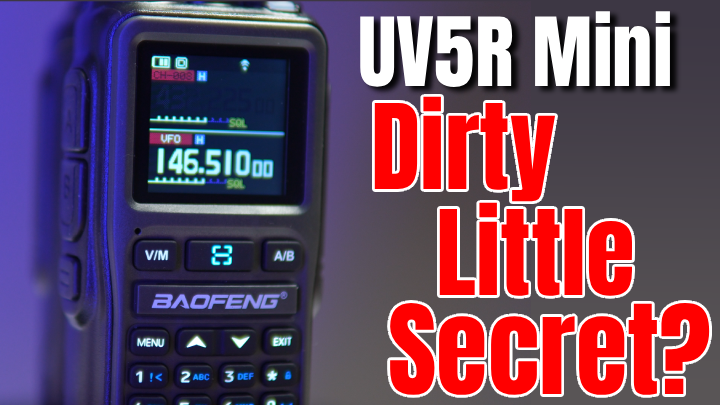
I thought I was about to do a normal HT write-up: bigger screen, USB-C charging, a couple quality-of-life tweaks, and a quick compare to the classic UV-5R. Then I watched a clip that made me put the “features” stuff on pause. If the radio is spraying harmonics, none of the nice-to-haves matter. This is a practical look at one UV5R Mini sample, how it was tested with an SDR tap into a dummy load, and what “dirty” really means for day-to-day ham use.
The Baofeng UV-5R Mini looks like Baofeng took the old idea and modernized it: a larger display that’s easier to read, a nicer PTT feel, and USB-C charging so you’re not hunting for a weird cable. You can even hit and hold “0” to pull up the weather channels. On paper, it’s the kind of update people have been asking for.
But “dirty” radios don’t get a pass because they’re convenient. When hams say a handheld is dirty, they usually mean the harmonic output and other spurious emissions are too high. That can be a problem even if you’re only chatting on a local repeater. It’s also why you’ll see a lot of heat online when different people test the same model and get different results.
What “dirty” means in plain ham terms
When you transmit on, say, 146.520 MHz, you want most of your energy right there on the fundamental frequency. Harmonics are multiples of that frequency (2x, 3x, 4x, 5x). A clean transmitter suppresses those harmonics strongly. A dirty one lets too much through. For VHF/UHF gear, a common benchmark you’ll hear is about 40 dB down from the carrier (the exact requirement depends on service and measurement method, but 40 dB is the number people quote for a reason). If you’re only 30-something dB down, that’s not “meh,” that’s “pay attention.”
The quick math from this test
| Metric |
Value |
Why It Matters |
| Fundamental level (tap reading) |
About 2.1 dBm |
This is the reference point for comparing harmonic suppression. |
| 5th harmonic difference |
32 dB down |
That’s short of the commonly expected ~40 dB suppression target. |
How the test was done (without the usual drama)
The goal was to remove variables and focus on relative levels. Instead of a pocket analyzer and mystery attenuation, the radio was terminated into a dummy load and sampled with an RF tap. The tap fed an SDR, which makes it easy to look at the fundamental and harmonics as separate measurements with the same setup.
- Step 1: Connect the UV5R Mini to a dummy load through a tuner that’s been modified with an RF sampler.
- Step 2: Feed the sampler output into an SDRplay RSP1A and view it in SDR Uno.
- Step 3: Measure the fundamental, then tune to the 5th harmonic frequency and measure again using the same tap path.
Why results vary between testers
If you’ve been following the chatter, you’ve probably seen people argue because one person gets a clean-ish plot and another person sees a harmonic spike. The boring answer is the most likely one: batch variation. Radios are built in runs, parts come from different lots, and QC on a $20 handheld is not going to look like QC on a commercial-grade unit.
- One batch might have a slightly different low-pass filter component value.
- One lot of parts might drift more at VHF/UHF than another.
- A unit that “passes” at one power setting might look worse at another.
What these numbers do (and don’t) prove
This is not a certified lab test. It’s a reality check. A tap-and-SDR approach is great for comparison and spotting “whoa, that’s loud” harmonics. It’s not the same as a calibrated spectrum analyzer measurement with documented uncertainty, absolute power, and a formal test procedure.
That said, seeing a 5th harmonic only 32 dB down is enough to stop and think. If you’re curious about cleaning up your station in general, check out our SDR section and Radio articles for more testing and troubleshooting ideas.
Practical tips if you own one
If you already bought the UV5R Mini (or you’re thinking about it), here’s how to be a good neighbor on the bands without turning it into a whole thing.
- If you can, test your own unit. An SDR and a safe tap into a dummy load will tell you a lot.
- Use the lowest power that reliably works. More power can mean more harmonic energy, depending on the design.
- Be smart about where you transmit. If you’re near sensitive services, or you’re in a dense RF area, “probably fine” isn’t a great plan.
Frequently Asked Questions
What does it mean for a handheld radio to be "dirty"?
When hams call a radio dirty, they mean its harmonic and spurious output is too high. Instead of putting most of the energy on the intended frequency, the transmitter also radiates at multiples of that frequency. A dirty handheld can interfere with other services and may not meet the suppression levels the hobby expects.
How far down should harmonics be on a VHF or UHF handheld?
The number commonly quoted in ham circles is around 40 dB below the carrier for VHF and UHF service. The exact requirement depends on the service, the measurement method, and the regulator, but 40 dB is the rough target most operators use as a benchmark for a clean handheld.
Was the UV5R Mini in this test actually dirty?
On this one sample, the 5th harmonic measured only about 32 dB below the fundamental in an SDR tap test. That falls short of the typical 40 dB suppression target and is a real reason to take a closer look. It is one unit and one test method, not a definitive verdict on the whole product line.
Can I trust an SDR-and-dummy-load tap as a real test?
An SDR-and-tap setup is excellent for relative comparisons between the fundamental and harmonics. It is not a calibrated lab measurement with documented uncertainty, so it cannot replace a certified spectrum analyzer test. For spotting an obvious harmonic problem, though, it is more than good enough.
Why do different testers get different results from the same handheld model?
Cheap handhelds are built in batches with looser quality control than commercial gear. Filter component values, parts lots, and assembly tolerances vary from run to run, which means one tester's clean unit can be another tester's harmonic mess. Power level and antenna setup can also shift the apparent results.
Should I stop using my UV5R Mini if I already own one?
You do not have to ditch the radio, but be a good neighbor on the bands. Test your own unit if you can, run the lowest power that does the job, and avoid transmitting near sensitive services or in dense RF environments where extra harmonic energy is more likely to cause real problems.
So, is the UV5R Mini dirty?
Based on this one sample and this test method, it sure looks that way. The 5th harmonic came in about 32 dB below the fundamental on the SDR tap, which is not where you want to be if you’re aiming for clean suppression.
- Nice features (USB-C, bigger screen) don’t offset RF cleanliness concerns.
- Batch variation is a real possibility, which is why your results might differ.
- A proper spectrum analyzer follow-up is the right next step for a definitive answer.
If you’ve tested your Baofeng UV-5R Mini, drop your results in the comments on the video above and tell us what you saw.